
What the Journey Behind Horseshoe Falls Is Really Like
Allow more than a spare 20-minute gap for this compact route. Crowding, portal waits and deck availability can change how long it takes.
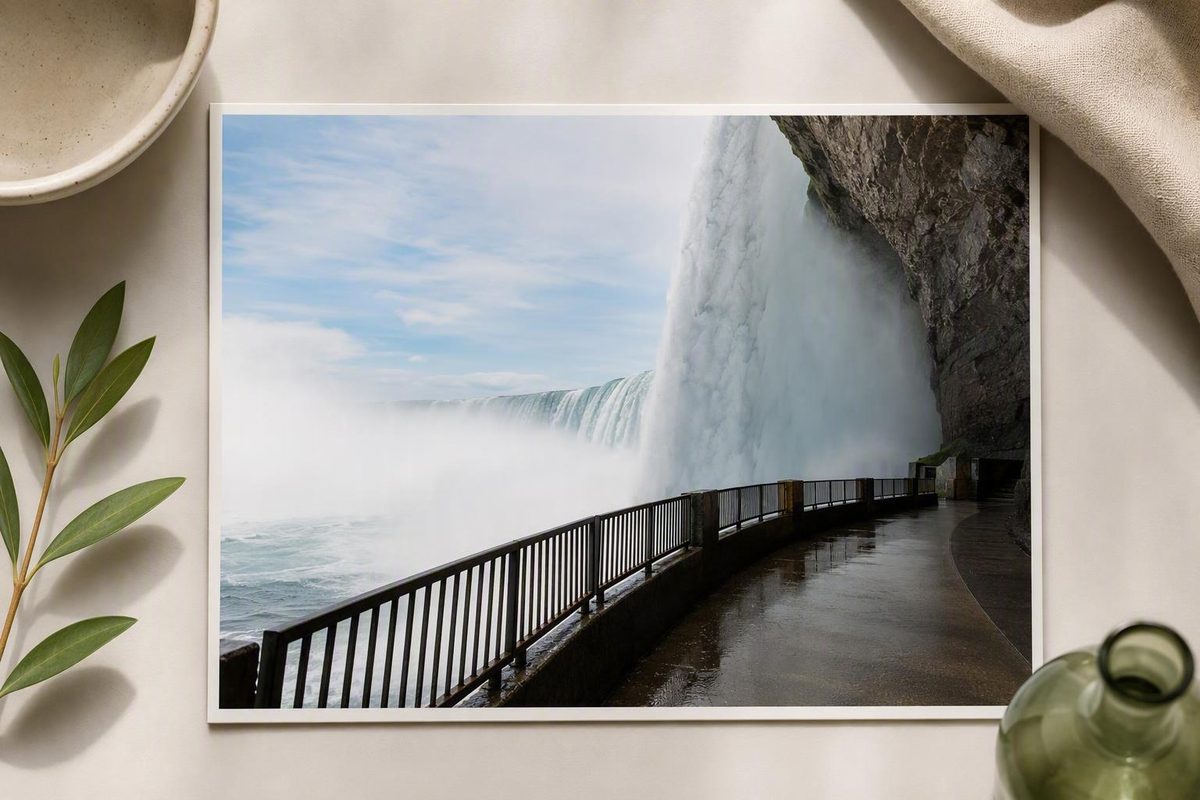
The direct answer: Can you walk behind Niagara Falls?
Yes—but the phrase “Niagara walk behind the falls” can create the wrong picture.
The official attraction is Journey Behind the Falls, inside Table Rock Welcome Centre beside Horseshoe Falls on the Canadian side of Niagara Falls. It is not a long outdoor hike, a route behind all three waterfalls or a continuous walkway directly beneath the falling water.
Instead, the experience follows a compact sequence:
- Enter through Table Rock Welcome Centre.
- Descend through the bedrock by elevator.
- Follow short underground tunnels.
- Look through the Cataract Portal and Great Falls Portal behind the falling sheet of Horseshoe Falls.
- Visit observation areas beside and below the waterfall.
Niagara Falls Tourism describes a 125-foot elevator descent followed by tunnels, two portals and outdoor viewing areas near the foot of Horseshoe Falls. It estimates approximately 30–45 minutes for the experience, although crowding and the time spent at each viewpoint can affect the total. See the Journey Behind the Falls overview from Niagara Falls Tourism.
The attraction is self-guided. There is no conventional tour group that must move through the entire route together, so visitors can generally pause at displays, wait for space at the portals and spend more or less time at the available observation areas.
The sensory experience can feel much larger than the short route suggests. Expect loud water, vibration, enclosed passages, crowds around relatively small viewing openings and substantial mist outdoors. You may leave damp even when a poncho is supplied.
The essential expectation is this: you are entering the rock behind and beside Horseshoe Falls, not taking a long walk underneath Niagara Falls.
The route, step by step: elevator, tunnels, portals, and decks
The route starts at the Journey Behind the Falls entrance inside Table Rock Welcome Centre. Because Table Rock stands beside the brink of Horseshoe Falls, there is no separate gorge hike before admission.
1. Enter and descend by elevator
After ticket validation and any admission queue, an elevator takes you 125 feet down through the bedrock. The elevator makes it possible to reach the tunnel level without descending a long staircase. It may nevertheless feel enclosed or crowded while groups are being moved between levels. Niagara Falls Tourism confirms the descent and basic route.
2. Follow the bedrock tunnels
At the lower level, the route continues through short tunnels cut into the rock. Niagara Parks describes them as approximately 8 feet wide and 7 feet high and identifies the attraction as self-guided, year-round and partially accessible. Review the official Niagara Parks attraction details.
This is the main walking portion, but it is not a trail in the usual sense.
No dependable official total walking distance or stair count is established in the supplied visitor information. Treat precise claims from undated third-party pages cautiously.
3. Look through the Cataract Portal and Great Falls Portal
The Cataract Portal and Great Falls Portal are openings through the rock behind the waterfall. They are not broad panoramic windows across the full curve of Horseshoe Falls.
From each opening, you face a dense, moving curtain of water. Depending on light, spray and water conditions, the view may be dominated by white water rather than the recognizable outline seen from above. The point is proximity, sound and force—not a wide landscape view.
Because the openings are limited in size, visitors often gather around them. You may need to wait briefly for a clear position, and busy conditions can limit how long any one person remains at the front.
4. Continue to the outdoor observation areas
The portals and outdoor areas provide different perspectives. The portals place you behind the falling water; the outdoor areas bring you beside and below Horseshoe Falls, where more of the waterfall and basin may be visible.
Mist, wind and changing weather are most noticeable outdoors. Access should therefore be confirmed for the date of your visit.
For planning purposes, picture the route as:
Table Rock entrance → elevator → bedrock tunnels → Cataract and Great Falls portals → upper observation area → stair-only lower deck when open
That sequence also helps visitors with mobility limitations identify where the step-free portion may end.
How long to allow—and where waiting changes the plan
Reserve 30–60 minutes for the attraction itself, then add time for arrival and queues.
Niagara Parks gives an approximate duration of 60 minutes, while Niagara Falls Tourism and a published attraction comparison estimate approximately 30–45 minutes. The difference is reasonable for a self-guided attraction: timing changes with crowding, portal waits, deck availability and how long each visitor remains at the viewpoints. See the published duration comparison.
Do not confuse experience time with the complete itinerary block. Your visit may also involve:
- Reaching Table Rock from a parking lot or transit stop
- Finding the entrance inside the welcome centre
- Buying or collecting tickets
- Waiting to join the admission line
- Waiting for an elevator
- Moving through congested portal areas
- Using the washroom or reorganizing damp belongings afterward
For a tightly planned Niagara day, use about one hour for Journey Behind the Falls plus a flexible queue buffer as a practical baseline. Some visits will take less time, but the attraction should not be squeezed into an uncertain 20-minute gap.
What a timed ticket actually does
Niagara Parks describes it as a one-hour window during which the holder may join the queue.
Traveler reports mention possible long lines and cramped viewing areas, but they do not establish dependable average waits for every month, weekday or hour. Treat advice that a particular time is “always quiet” as a possibility, not a promise.
How to protect the rest of your itinerary
Use three scheduling rules:
- Give the attraction a fixed block. Do not assume it can always be completed in a spare few minutes.
- Keep the next stop nearby. A meal, viewpoint or flexible walk around the falls is easier to adjust than a distant reservation.
- Avoid a nonrefundable departure immediately afterward. Leave recovery time before a tour pickup, intercity connection or event with a strict start.
This is particularly important on a Toronto day trip. The physical route is compact, but an unpredictable admission queue can affect every later stop.
Tickets, prices, hours, and what must be checked before visiting
Niagara Parks lists three basic admission paths:
- Timed online tickets, which provide a designated one-hour window for joining the queue
- Anytime online tickets, subject to the conditions and inventory offered for the selected date
- In-person purchases, subject to remaining availability
The supplied official listing also displays the prices, tax treatment, age bands and limited-date operating hours below. Because no documented live-verification date accompanied that listing, these figures should be treated as a sourced snapshot rather than a guarantee of the rate or schedule available when you book. Confirm all ticket details on the official Niagara Parks page immediately before publication or purchase.
Displayed standalone admission
Verification status: Displayed in the supplied official listing; live-check date not documented.
| Visitor | Displayed price |
|---|---|
| Age 13 and older | CAD $33 |
| Age 3–12 | CAD $21.50 |
| Age 2 and under | Free |
The displayed prices exclude 13% HST. Prices, tax treatment, age categories, inventory and purchase conditions can change. If a current official check cannot be completed, do not rely on these figures as confirmed present-day rates.
The official page should also be consulted for change and refund terms, which may vary by ticket type or sales channel.
Hours vary by date
Journey Behind the Falls operates year-round, but it does not maintain one permanent daily schedule. The supplied official listing showed 8:00 a.m.–10:00 p.m. for August 16–22 only. That limited date range must not be applied to another week, month or season.
The same listing recommends arriving at least one hour before closing. Reaching Table Rock shortly before closing does not eliminate the time required for ticket processing, queues or the elevator.
Immediately before visiting, verify:
- Admission prices and taxes
- Official child age bands
- Opening and closing times for your date
- Timed and anytime ticket inventory
- In-person ticket availability
- Weather or maintenance restrictions
- Lower-deck access
- Change, cancellation and refund conditions
Official tickets versus commercial packages
A commercial package may cost substantially more than standalone admission because it can include transportation, a guide, a boat cruise, Skylon Tower admission, hotel pickup or another service. Package durations may also cover several hours rather than only Journey Behind the Falls.
Compare inclusions line by line. If you need only the tunnel attraction and can reach Table Rock independently, official standalone admission is generally the simplest product to understand. A bundle is more useful when it replaces transportation or other attraction bookings you would otherwise arrange separately.
Terms such as “priority,” “reserved” or “skip the line” apply only to the specific commercial product advertising them. Do not assume that such wording eliminates every attraction-controlled queue unless the seller states exactly which line is bypassed.
Mist, clothing, photography, and seasonal differences
Expect mist, particularly on the outdoor observation areas. The amount varies with wind, water and position, but visitors can leave with damp clothing, hair and exposed belongings.
Niagara Falls Tourism supports complimentary biodegradable ponchos in spring and summer, while a local attraction guide describes them during peak season. Inclusion is not established for every date, so confirm whether one will be supplied. Even when available, a poncho is partial coverage—not a guarantee that clothing, shoes or electronics will remain dry.
As practical preparation, wear securely fitting footwear suitable for damp surfaces and minimize loose belongings. A water-resistant phone case or protected inner pocket may be useful, but no accessory should be treated as complete protection against water or accidental damage.
Photography expectations
The portals can be difficult places for clean photographs. The water is close, the view may be dominated by white spray and other visitors may be waiting for the same position. On the outdoor areas, mist can collect on a lens quickly.
A practical approach is to:
- Take a few photographs before the lens becomes wet.
- Keep a dry cloth in a protected pocket.
- Use a secure grip or wrist strap.
- Avoid opening equipment bags or changing lenses in heavy spray.
- Move aside after taking a photograph so others can approach the portal.
The most memorable part may be the noise, vibration and physical proximity rather than the resulting image.
How the experience changes by season
Year-round operation does not mean every component is open every day. A local Niagara guide reports that the lower deck closes in winter while the upper area, tunnels and portals remain open. Check the seasonal access summary before a cold-weather visit.
| Period | Likely deck situation | Poncho information | Exposure and viewing |
|---|---|---|---|
| Spring | Outdoor access subject to conditions | Complimentary biodegradable ponchos are described for spring | Cool mist and changing weather |
| Summer and peak season | Greatest likelihood of full access, but not guaranteed | Ponchos are commonly described | Heavy mist, busier viewpoints and longer daylight |
| Autumn | Access depends on weather and operations | Confirm for the date | Cooler spray and variable conditions |
| Winter | Lower deck may close because of ice; tunnels and portals generally remain available | Do not assume inclusion | Cold exposure, reduced access and possible winter rates |
| Nighttime dates | Depends on the schedule, ticket and operating program | Confirm for the booked experience | Illumination may be visible; fireworks are seasonal |
Niagara Parks promotes nighttime viewing of the illuminated falls and, during fireworks season, views of scheduled fireworks from the observation area. Neither fireworks nor a special nighttime program should be assumed for an unspecified date.
Accessibility, strollers, children, and sensory considerations
Journey Behind the Falls is best described as partially accessible, not fully wheelchair accessible.
The elevator-and-tunnel portions are generally reported as step-free, but the lower observation deck requires stairs. Because the official designation does not identify every accessible element or operating restriction, wheelchair and mobility-scooter users should confirm the current route directly with Niagara Parks.
Ask specifically:
- Can my mobility device enter the elevator and every open tunnel section?
- Which portals and observation areas are step-free?
- Is the upper outdoor area accessible today?
- Is the lower deck closed or reachable only by stairs?
- Are devices subject to size or elevator-capacity limits?
- Is any assistance equipment currently available?
Do not rely on a general statement that “most” of the attraction is accessible when a particular viewpoint may be the area you most want to visit.
Strollers and young children
Strollers are not permitted inside. Families must plan how a child will move through the attraction without one. Do not assume stroller storage, lockers, baby carriers, loan wheelchairs or other equipment will be available; confirm any essential service before arrival.
Use the current official age bands when buying tickets. Older third-party pages contain conflicting child-admission rules and should not be used for budgeting.
Before booking with a young child, consider:
- Can your group leave the stroller outside?
- Is the child comfortable using an elevator?
- Are enclosed rock tunnels likely to be manageable?
- Can the child tolerate very loud water and vibration?
- Are you prepared to carry the child if necessary?
- Can you keep spare clothing and essential items protected from mist?
Sensory conditions
Although the route is short, it combines several intense sensations:
- A substantial elevator descent
- Enclosed underground passages
- Loud, continuous water noise
- Vibration through the rock and viewing areas
- Crowds in relatively narrow spaces
- Mist and moving air
- Limited viewing room at the portals
These conditions do not make the attraction unsuitable for everyone who dislikes noise or enclosed spaces, but they are worth considering before purchase. A family may decide that viewing Horseshoe Falls from the Table Rock area is sufficient, or that one adult should enter while another remains outside with a child or stroller.
Traveler guidance describes much of the elevator-and-tunnel route as accommodating wheelchairs or mobility scooters while identifying the lower deck as lacking step-free access. Treat that as planning guidance rather than a guarantee of current conditions. Review the third-party accessibility and stroller overview.
Getting to Table Rock without an address mix-up
The clearest destination is Journey Behind the Falls inside Table Rock Welcome Centre, beside Horseshoe Falls.
That venue name is more dependable for navigation than a street number alone. Supplied Niagara Parks material uses both 6635 Niagara Parkway and 6650 Niagara Parkway in different parts of its visitor information. Both references point toward the Table Rock complex, but the discrepancy makes the named venue or official parking destination a safer search term.
If driving, navigate to either:
- Table Rock Welcome Centre, or
- Falls Parking Lot A
Niagara Parks identifies Falls Parking Lot A as the closest parking option. Check the current official map or parking information for the entrance, charges and closures before departure.
“Closest” does not mean no walking. Allow time to park, cross to the welcome centre, find the attraction inside and reach the ticket or admission area.
Arriving by WEGO
Local visitor information reports that WEGO’s Green and Blue lines serve Table Rock Centre. Routes, stops and service frequency can change, so check the current system map and timetable rather than relying on an undated description.
The same local guide reports washrooms at Table Rock Centre and on the attraction’s main level. Check the local access, transit and facilities overview.
Planning the stop from Toronto
For a Toronto-based visitor, treat Journey Behind the Falls as one fixed appointment within the Niagara day. Do not build the itinerary around an unsupported driving or rail estimate that leaves no margin for traffic, transfers, parking or queues.
A workable structure is:
- Arrive in the Table Rock area.
- Complete Journey Behind the Falls within its reserved block.
- Keep the following activity within the falls area.
- Add more distant attractions only after accounting for transportation.
- Preserve a buffer before returning to Toronto.
Commercial Toronto day trips may combine transportation with Journey Behind the Falls, a boat cruise, guided walking, hotel pickup or another attraction. Pickup locations, admission, timing and seasonal inclusions vary by product. A marketplace can display everything from local attraction combinations to full Toronto transportation packages, so read the specific itinerary rather than relying on the phrase “Niagara day tour.” Compare package formats and inclusions on Viator.
A bundle can reduce coordination when it includes the transport and admissions you already want. It can also reduce flexibility if the group schedule allows little time at a viewpoint.
Journey Behind the Falls vs. the boat cruise—and whether to do both
Journey Behind the Falls and the Canadian boat cruise offer different perspectives. Neither is universally better.
Journey Behind the Falls is stationary and focused primarily on Horseshoe Falls. Visitors descend through the rock, look through portals behind the falling water and stand at observation areas beside and below it.
The Canadian boat cruise is a moving experience. It passes the American Falls and Bridal Veil Falls before approaching the Horseshoe Falls basin. One published comparison describes the cruise as approximately 20 minutes, compared with about 30–45 minutes for Journey Behind the Falls. See the route and duration comparison.
| Consideration | Journey Behind the Falls | Canadian boat cruise |
|---|---|---|
| Main perspective | Behind, beside and below Horseshoe Falls | Moving view past multiple falls and into the Horseshoe Falls basin |
| Format | Elevator, tunnels, portals and observation areas | Boat journey on the river |
| Pace | Self-guided | Fixed route and duration |
| Typical experience time | Approximately 30–60 minutes inside | Approximately 20 minutes in the cited comparison |
| Wetness | Mist and spray, especially outdoors | Mist and spray depending on position and conditions |
| Season | Year-round, with possible winter deck restrictions | Seasonal or date-dependent |
| Mobility considerations | Partial accessibility; lower deck requires stairs | Boarding and vessel access must be checked with the operator |
| Best fit | Close stationary viewing and a tunnel experience | Wider moving views involving multiple waterfalls |
Do not select Journey solely because you expect to stay drier. Both experiences involve mist, and exposure varies with wind, water and position. Likewise, the boat does not guarantee clear photographs; heavy mist can reduce visibility near Horseshoe Falls.
Choose Journey Behind the Falls if…
- You want to experience the sound and vibration from within the bedrock.
- The portals and stationary close-up viewpoints appeal to you.
- You prefer a self-guided attraction.
- You are visiting outside the boat’s operating season.
- You are satisfied with the route currently accessible to you.
Choose the boat cruise if…
- You want a moving, wider view.
- Seeing the American Falls, Bridal Veil Falls and Horseshoe Falls on one route matters to you.
- The cruise operates on your date.
- You are comfortable with the boarding requirements, fixed schedule and likely mist.
Choose both if…
The schedule, mobility requirements, season and budget allow. The experiences are complementary rather than repetitive: one takes you into the rock beside Horseshoe Falls, while the other changes your position across the river.
If you do both, do not treat the published experience durations as the entire time commitment. Each attraction can involve separate admission procedures, queues and travel between entrances.
Commercial marketplaces list combinations involving Journey Behind the Falls, boat rides, walking tours, Skylon Tower and Toronto day trips. Product durations and advertised access vary, so inspect the meeting point, transportation, attraction admission and cancellation terms for the exact listing. See examples of bundled products on GetYourGuide.
Official standalone admission remains simpler when you need only Journey Behind the Falls and will arrange your own arrival. A package makes more sense when it solves another planning need, such as transportation, a guide, a seasonal cruise or admission to an additional attraction.
Frequently asked questions
Is Journey Behind the Falls a long walk?
No. The attraction involves an elevator descent followed by short bedrock tunnels, two portals and nearby observation areas. It includes relatively little walking compared with a gorge trail or outdoor hike, although visitors may spend additional time standing in lines or waiting at viewpoints.
The lower observation deck requires stairs when open. No dependable official total walking distance or stair count is established in the supplied visitor information.
Do you get wet at Journey Behind the Falls?
You can. The tunnels and portals may feel damp, while outdoor observation areas receive more mist and spray. Wind and position affect how wet you become.
Ponchos are described for spring, summer or peak-season visits, but inclusion should be confirmed for your date. A poncho does not guarantee that clothing, shoes or electronics will remain dry.
Is Journey Behind the Falls open in winter?
The attraction operates year-round, but winter access can be reduced. The lower outdoor deck may close because of ice or weather while tunnels, portals and other available areas generally remain open. Reduced winter rates may apply.
Check the current operating notice because year-round operation does not guarantee that every observation area will be accessible.
Is Journey Behind the Falls wheelchair accessible, and can I bring a stroller?
It is partially accessible. The elevator-and-tunnel route is reported as largely step-free, but the lower observation deck requires stairs. Mobility-device users should ask Niagara Parks which portals and observation areas are accessible on the planned date.
Strollers are not permitted inside. Confirm storage or assistance arrangements rather than assuming they will be available.
Should I book Journey Behind the Falls or the Niagara boat cruise?
Choose Journey Behind the Falls for tunnels, portals, stationary close-up views of Horseshoe Falls and a year-round attraction with possible seasonal restrictions.
Choose the boat for a moving view involving multiple waterfalls, provided it operates on your date. Choose both when your time, budget, mobility requirements and season allow; the viewpoints are complementary rather than duplicates.
Before you book: the practical takeaway
Journey Behind the Falls is a compact elevator-and-tunnel experience focused on Horseshoe Falls, not a long walk beneath Niagara Falls.
Reserve roughly an hour plus a queue buffer, prepare for mist and confirm current prices, hours, ticket conditions, poncho availability, accessibility and deck access before leaving. Choose standalone admission if you only need the attraction; consider a bundle when it also provides transportation, a boat cruise, a guide or another admission you already intend to book.