
What You’re Really Seeing When Niagara Turns to Ice
High winds moved Lake Erie ice into a blockage near the source of the Niagara River, interrupting river flow for roughly 30 hours.
Updated August 21, 2026. Hydrological and historical claims in this guide were checked against Niagara Parks and Niagara Falls USA. Attraction access, weather conditions and operating schedules can change, so verify them directly before travelling.
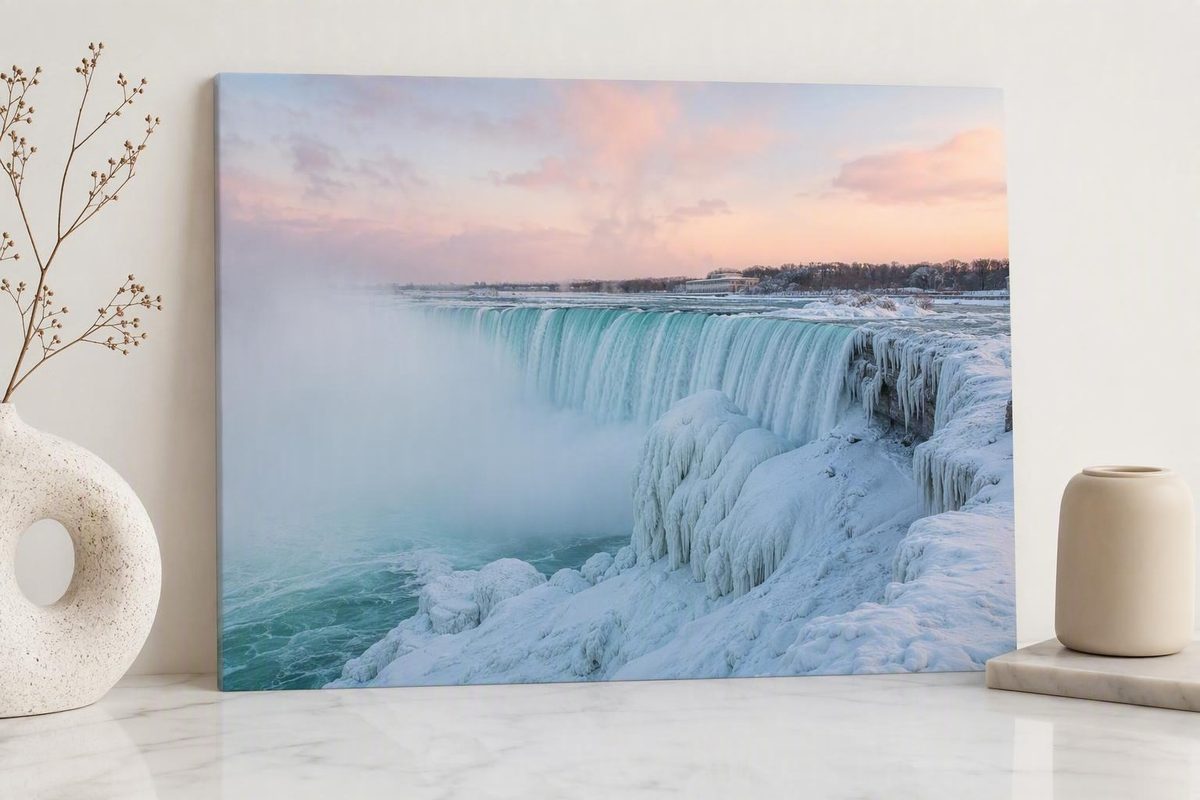
Search for “frozen Niagara Falls” and you will find images that appear to show a waterfall locked in place: white curtains, enormous icicles, snow-covered boulders and a basin filled with ice. The spectacle is real, but the usual description is misleading.
Niagara Falls does not normally freeze solid. During a typical cold-weather display, water continues to move while frozen mist, spray, snow and surface ice partly conceal it. Understanding that distinction makes the winter landscape no less impressive—and helps visitors arrive with realistic expectations.
The short answer: Niagara Falls looks frozen but normally keeps flowing
Even when Niagara Falls appears motionless in a photograph, the waterfall has not ordinarily become a solid wall of ice. Cold weather builds ice around and sometimes over sections of moving water, producing a convincing frozen appearance. The Niagara Falls State Park winter guide emphasizes the essential point: the Falls may look frozen while the water continues to flow.
Three different conditions are often blurred together:
- An icy or frozen appearance: Snow, frozen mist and icicles cover the surrounding landscape and obscure parts of the cascade.
- Partial ice accumulation around flowing water: Ice forms on cliffs, rocks, trees, shoreline features and existing ice near the base while liquid water remains visible—or hidden beneath a crust.
- An interruption of Niagara River flow: Water reaching the Falls is sharply reduced or interrupted by an upstream event. This is fundamentally different from the falling water freezing in place.
Most winter photographs show the first two conditions. Snow softens the contours of the gorge. Icicles hang from ledges. Frozen pools and shoreline buildup make the base look solid. Ice-covered rocks can visually merge with descending water, while mist hides gaps where the flow remains active.
The illusion is especially strong in a still image. A photograph cannot show motion beneath a surface crust or convey the waterfall’s continuing roar. Bright ice can also obscure darker channels of water, making the entire scene appear more static than it is.
For accuracy, it is better to call Niagara ice-covered, partially iced or frozen-looking. “Frozen solid” is more useful when discussing and correcting sensational descriptions than when characterizing normal winter conditions.
At a glance: What might you see?
- After sustained cold: Large icicles, thick crusts, ice-coated rocks and extensive white formations around the gorge.
- During ordinary winter weather: A mixture of snow, smaller ice formations, open water and visible cascades.
- During windy or misty conditions: Moving water may be difficult to see clearly even though it is still flowing.
- During a mild spell: Relatively modest ice, wet rock and scenery that resembles late autumn more than a deep freeze.
No winter date guarantees a particular version of the scene.
A useful way to read any “frozen Niagara Falls” image is to look for darker vertical channels, rising mist or open water near Horseshoe Falls. These clues often reveal the movement concealed by brighter ice.
How the frozen appearance forms around moving water
The process begins with the Falls themselves. Descending water generates abundant mist and spray. Some droplets remain suspended in the air; others are carried onto nearby cliffs, rocks, vegetation and built surfaces.
When subfreezing conditions persist, some of that moisture freezes where it lands. The process repeats:
- Water drops over the Falls and produces spray.
- Wind and turbulence carry moisture toward nearby surfaces.
- Some droplets freeze onto cold rock, trees, snow, railings and existing ice.
- Additional moisture lands on the frozen layer.
- Repeated deposition creates crusts, icicles and progressively thicker formations.
The result is not a single, uniform shell. Ice may grow beside the cascade, project in front of it or sit over channels where water continues to move. Some formations are thin and translucent; others become bulky enough to hide substantial portions of the rocks and water behind them.
Accumulation can appear on:
- Cliff faces and ledges
- Trees, shrubs and low vegetation
- Rocks at the edge of the river
- Talus and boulders below the American Falls
- Railings and other exposed surfaces near overlooks
- Snowbanks and existing ice around the base
- Shoreline areas and quieter pools
This explains how photographs can show what looks like a continuous white curtain without demonstrating that the full cascade has turned to ice. A visible formation may be sitting in front of liquid water rather than replacing it.
It also helps to distinguish three forms of winter ice:
- Frozen spray and surface accumulation form when airborne moisture freezes onto nearby surfaces.
- Floating river ice consists of ice moving through the river system.
- An ice bridge is a larger accumulation in the lower river below the Falls, formed when ice collects and consolidates during sustained cold.
These processes can occur together, but they are not interchangeable. An ice-covered cliff does not mean the river has stopped, and an ice bridge below the Falls does not prove that the waterfall has frozen solid.
The available destination guidance does not establish a precise temperature threshold or a minimum number of cold days required to create a dramatic display. Prolonged cold matters, but so do recent weather patterns, moisture, wind, temperature changes and viewing position. One cold day is therefore less informative than the broader trend.
It is also unnecessary to argue that the kinetic energy of the water, by itself, makes complete freezing impossible. The more defensible explanation is observational: under normal winter conditions, substantial water continues to flow while ice accumulates on and around it.
Why the American Falls often look more frozen than Horseshoe Falls
Niagara is not one uniform waterfall. The three sections relevant to a winter visit are:
- American Falls
- Bridal Veil Falls
- Horseshoe Falls
They do not receive equal amounts of water, and their bases do not look the same. Those differences help explain why the American Falls often appear more dramatically frozen in winter photographs.
Niagara Parks reports that approximately 7% of Niagara River flow goes to the American Falls, with the remainder going over Horseshoe Falls. That much smaller share allows ice, snow and rock to occupy more of the visible scene at the American Falls (Niagara Parks’ explanation of winter flow and ice).
There is another important visual factor: talus. The base of the American Falls contains a mass of rockfall debris. Once those rocks are coated with snow, frozen spray and icicles, they form a broad white foreground that can look like part of the frozen waterfall. The boundaries between falling water, ice-covered rock and accumulated snow become difficult to read.
At Horseshoe Falls, the greater visible volume of moving water is generally easier to recognize. Even during severe cold, visitors may see open channels, dark green or grey water and dense mist rising above the curved brink. Horseshoe Falls can still develop striking ice around its edges and base, but active water tends to remain more visually prominent.
| Feature | American Falls and Bridal Veil Falls | Horseshoe Falls |
|---|---|---|
| Relative flow | Substantially lower | Receives most of the river flow reaching the Falls |
| Common winter impression | Can appear heavily iced or nearly motionless from some angles | Usually retains more obvious visible movement |
| Base feature | Extensive talus can become coated in ice and snow | Larger visible expanse of turbulent water and mist |
| Useful U.S.-side position | Prospect Point | Goat Island |
| Useful Canadian-side position | Broad cross-river views of the white face | Panoramic views of the curve and rising mist |
| Important caveat | Appearance changes with weather and angle | Heavy mist can hide water even when ice is limited |
This is a visual tendency, not a daily guarantee. A photograph taken with a long lens, from a particular angle or during heavy mist may make either section look more frozen than it appears in person. Light matters too: bright ice in direct sun can dominate a frame while open water recedes into shadow.
For photographers, the distinction suggests two different compositions. Use the American Falls when you want details such as icicles, layered ice and snow-covered talus. Use Horseshoe Falls when you want to show the contrast between active water, mist and the frozen landscape around it.
Winter water diversion makes the ice more conspicuous
The amount of water going over Niagara Falls is affected not only by natural conditions but also by diversion for hydroelectric generation. Destination organizations on both sides report greater diversion during winter than during the warmer visitor season.
Niagara Parks reports that approximately 75% of Niagara River water is diverted in winter, compared with about 50% from April through October. Its broad estimates put winter flow over the Falls at roughly 85 million litres per minute, compared with approximately 170 million litres per minute during the warmer-season period described by the park.
Niagara Falls USA likewise reports the 75% winter and 50% warmer-season diversion figures and estimates that about 20 million gallons still pass over the Falls each minute in winter (Niagara Falls USA’s winter-flow explanation).
These are destination-source operating estimates, not independent, moment-by-moment measurements. They should not be interpreted as a promise that flow will be identical whenever a visitor arrives.
Reduced winter flow can make ice formations more conspicuous. With less visible water—particularly at the American Falls—frozen spray, snow and ice-coated rock occupy a larger proportion of the scene. That strengthens the appearance of a deep freeze without showing that the waterfall is close to becoming solid.
Water diversion also helps explain why photographs from different seasons can look dramatically different even before snow and ice are considered. Winter combines reduced flow, low temperatures, snow cover, frozen spray and altered light. Those elements reinforce one another visually.
The 1848 stoppage, the ice bridge, and the modern ice boom
The historical exception behind many “Has Niagara Falls ever frozen?” stories occurred in March 1848. High winds moved Lake Erie ice into a blockage near the source of the Niagara River, interrupting river flow for roughly 30 hours.
The key point is the cause. This was an upstream ice-dam event, not the falling water gradually freezing into a solid curtain. Once the blockage shifted and gave way, the river resumed its course (Niagara Falls USA’s account of the 1848 interruption).
That distinction also guards against overreading old captions. Historical photographs and videos may be labelled “frozen solid,” including material associated with the winters of 1936 or 1937. A dramatic title does not establish that Niagara River flow stopped. Without stronger documentation, such images are better treated as records of severe icing than as proof of another complete interruption.
What is an ice bridge?
An ice bridge is an accumulation of ice in the lower Niagara River below the Falls.
Its name does not mean that it is a safe pedestrian bridge. Natural river ice can be unstable and may shift or break apart as temperatures and flow conditions change. Visitors must never step onto an ice bridge, frozen basin or other natural ice formation, and must obey all barriers and path closures.
Public recreation on the Niagara ice bridge began in the 1880s. It ended after a breakup during a mild spell in 1912 killed three people. Niagara Parks also reports that an ice boom approximately 2.7 kilometres, or 1.7 miles, long has been used between Fort Erie and Buffalo since 1964 to manage floating ice and reduce blockage and damage risks.
A concise winter-ice timeline
| Date | Event | What it means |
|---|---|---|
| March 1848 | Wind-driven Lake Erie ice blocked the Niagara River upstream | Flow was interrupted for about 30 hours; the falling water did not simply freeze in place |
| 1880s onward | Public recreation took place on the lower-river ice bridge | The natural ice was treated as an attraction despite its instability |
| 1912 | Three people died when the ice bridge broke up during a mild spell | Public recreation on it ended |
| 1964 onward | The Fort Erie–Buffalo ice boom came into use | Floating ice is managed to reduce blockage and damage risks |
Timeline source: Niagara Parks, “The Frozen Falls.”
The boom is risk-management infrastructure, not an absolute guarantee. It would be too strong to say another 1848-style blockage is impossible. Its purpose is to manage floating ice and reduce risk, not to eliminate every conceivable combination of weather, ice and river conditions.
When to look for extensive ice—and why no month guarantees it
January and February generally offer the best chance of seeing extensive formations, but recent sustained cold matters more than the month printed on a reservation. Tourism guidance commonly identifies those months as the strongest period for major ice while emphasizing that occurrence and duration depend on weather (winter timing guidance for Niagara’s ice formations).
December is an early-winter transition. It can deliver snow, icicles and intense cold, but it can also be comparatively mild. Even if the air is cold on the day of a visit, there may not have been enough preceding cold for large formations to develop.
January usually brings stronger midwinter potential. February can also produce substantial accumulation, particularly after consecutive freezing days. Ice may persist into later winter when conditions support it, but later does not automatically mean more. A thaw, rain event or mild spell can quickly change the scene, while a late cold snap may create impressive formations after an otherwise mild season.
| Period | Reasonable expectation | What could change the result |
|---|---|---|
| December | Early-winter variability; possible snow and moderate icing | Mild periods, rain or insufficient preceding cold |
| January | Stronger potential for extensive formations | Thaws, wind, mist and changing visibility |
| February | Often a good chance after sustained cold | A warm spell can reduce or destabilize visible ice |
| Later winter | Existing ice may persist or new ice may form | Rising temperatures and changing river conditions |
No defensible planning rule says that a specific temperature guarantees an ice-covered Niagara Falls. The available evidence also does not establish a reliable annual frequency or average duration. Conditions can range from modest icicles to widespread formations around the gorge and base.
Check the trend, not just the day
A forecast showing cold weather on the day of arrival is useful, but the preceding week may reveal more about likely ice buildup. Look for a sustained pattern rather than relying on one overnight low.
Shortly before departure, check:
- Recent and forecast temperatures
- Wind and wind-chill conditions
- Snow, freezing rain or thaw forecasts
- Official park alerts and path closures
- Provincial, state and local road reports
- Current photographs or webcams, where available
- Attraction and operator pages
- Illumination and event schedules
Current images are particularly useful because “winter conditions” can describe very different scenes. A webcam may show extensive ice, heavy mist, bare wet rock or near-whiteout visibility during the same calendar month.
Avoid planning a trip around a single viral image unless you know when it was taken.
Choosing winter viewpoints on the U.S. and Canadian sides
There is no universally best side for seeing frozen Niagara Falls. The more useful question is what kind of view you want: proximity to ice detail, a broader panorama, a strong view of Horseshoe Falls or an indoor alternative to an exposed overlook.
For proximity to American Falls ice: the U.S. side
Prospect Point provides a view toward the American Falls and Bridal Veil Falls. In cold conditions, this area can emphasize icicles, ice-coated rock, the gorge and the snow-covered talus below the American Falls.
Goat Island offers positions looking toward Horseshoe Falls. It works well when you want active water and mist in the same composition as the surrounding winter ice. Niagara Falls USA identifies Prospect Point and Goat Island as distinct winter-photography locations.
The Observation Deck may provide another perspective, but its access is weather-dependent. Do not build a winter plan around it without checking current park information.
The U.S. side is especially useful for studying individual features: textured ice, cliff edges, narrow cascades and the relationship between the American Falls and the rocks below. The trade-off is exposure. Wind and mist can make paths and overlooks feel considerably colder.
For a wider panorama: the Canadian side
Canadian-side positions can provide broad views containing both Horseshoe Falls and the American Falls. This makes them useful for understanding the scale of the entire complex or contrasting the visibly active Horseshoe Falls with the icier-looking American Falls.
A panorama is not automatically better than proximity. The broader view may sacrifice ice detail, and heavy mist can obscure the curve of Horseshoe Falls. It is nevertheless well suited to wide compositions and to visitors who want both major sections in one visual field.
Elevated or indoor possibilities include Skylon Tower and falls-view rooms. Treat these as options to investigate rather than guarantees. Visibility, window conditions, room orientation, hours and access can all affect the result.
| Location or type | Country | Principal subject | Likely visual strength | Weather exposure | Verify access? |
|---|---|---|---|---|---|
| Prospect Point | U.S. | American and Bridal Veil Falls | Ice detail, talus and a frontal waterfall view | High | Yes |
| Goat Island | U.S. | Views toward Horseshoe Falls | Contrast among water, mist and ice | High | Yes |
| Observation Deck | U.S. | Broader river and Falls perspective | Elevated composition when accessible | High | Essential |
| Canadian riverside viewpoints | Canada | Horseshoe and American Falls | Broad panorama across the complex | High | Yes, especially after storms |
| Elevated indoor viewpoint | Canada | Wider landscape | Shelter and height | Lower outdoor exposure; visibility varies | Essential |
| Falls-view room | Canada | Depends on room orientation | Warm, repeatable viewing | Low | Confirm the actual view before booking |
Daylight and illumination are different experiences
Daylight is generally more useful for reading the structure of the ice.
Evening illumination creates a different scene. Colour can make the ice appear theatrical, but darkness hides some physical detail. If photography is a priority, treat daylight and illumination as separate sessions rather than expecting one to substitute for the other.
Illumination may continue through winter, while fireworks and related events can be limited to selected dates. Niagara Falls USA describes illumination as a winter option but notes that fireworks are offered only on select nights, so verify the current schedule before returning in the evening.
Plan for cold, closures, and a flexible winter day
The winter trade-off is straightforward. You may encounter unusual ice-covered scenery and fewer people than during peak warm-weather periods. In return, you accept severe cold, slippery surfaces, changing visibility and reduced seasonal services.
Conditions around the Falls can feel harsher than a temperature reading suggests. Mist adds moisture, exposed overlooks offer little protection from wind, and icy surfaces require caution. Winter tourism guidance recommends warm layers and careful footing while advising visitors to check conditions before travelling (cold-weather and icy-surface guidance).
What to wear and carry
Use a practical cold-weather checklist:
- Insulating base and middle layers
- Warm, weather-resistant outerwear
- A hat that covers the ears
- A scarf or neck covering
- Insulated gloves
- Insulated, weather-appropriate footwear
- Soles with useful traction
- Dry socks and, for a longer visit, a spare pair
- Moisture protection for a phone or camera
- A small cloth for wet lenses or screens
- Spare phone or camera power carried in a protected inner pocket
Niagara Falls Tourism recommends layers, warm outerwear, gloves, a scarf and a hat, while cautioning that some seasonal attractions may not operate (official winter clothing and planning guidance).
For photography, gloves that permit camera or touchscreen operation reduce the need to expose bare hands. Protect equipment from spray, and consider allowing cold gear time to adjust when moving into a warm interior.
Do not let photography override basic judgment. A slightly better angle is not worth crossing a barrier, standing on natural ice or entering a closed path.
Assume operations can change
Boat tours, gorge access, elevators, snowshoeing, fireworks and other activities may be seasonal, weather-dependent or subject to operator decisions. Published travel accounts conflict about the winter status of some attractions, including Journey Behind the Falls, and any schedule can change after an article is published.
The correct planning approach is therefore not “open all winter” or “closed all winter.” Instead:
- Identify the attraction you would like to visit.
- Check its current operator page close to departure.
- Look for date-specific hours and weather notices.
- Confirm again on the day if conditions are poor.
- Keep an indoor substitute that does not depend on the same weather.
The Niagara Falls State Park winter itinerary suggests indoor warming opportunities alongside outdoor viewing, but it does not establish that every experience will operate under all winter conditions.
Pre-departure checklist
Before leaving, verify:
- The current forecast and wind chill
- Freezing rain, snow-squall or visibility warnings
- Road reports along the full route
- Park notices and path restrictions
- Attraction hours and operator updates
- Elevator or gorge-access status
- Boat-tour status
- The current illumination schedule
- Fireworks or event dates, if relevant
- Parking and local transportation conditions
- Applicable border and travel-document requirements if crossing countries
- A warm indoor fallback
- A realistic point at which you will turn back
For anyone adding Niagara Falls to an Ontario itinerary, avoid building a rigid sequence of reservations and exposed overlooks. A winter visit works better when the outdoor portion can be shortened, moved or divided by an indoor break.
Three flexible ways to structure the visit
1. A short daylight viewing stop
Choose one principal viewpoint and one nearby backup. Arrive during daylight, spend enough time to see the major formations and leave before cold exposure begins to dominate the experience.
This structure suits visitors who mainly want to understand what frozen-looking Niagara Falls looks like. It also works when roads are passable but conditions are too unstable for a long outdoor day.
2. A longer visit with a warming break
Begin at an exposed viewpoint, move indoors for food or an attraction, and then reassess conditions before returning outside. This gives the weather time to change and reduces the temptation to push through the cold simply because another overlook appears on the itinerary.
Keep the second outdoor session optional. If visibility deteriorates or paths close, let the indoor stop become the end of the visit.
3. A photography-focused visit with an evening return
Use daylight for details and wider landscape compositions. Then leave the exposed area, warm up and return only if conditions remain suitable for illumination.
This approach avoids several continuous hours outdoors and recognizes that daylight ice photography and nighttime illumination are different goals. Do not assume fireworks will accompany the lights; check the date-specific schedule.
Know when to shorten the plan
Reduce or abandon the outdoor plan when:
- A park closes a path or overlook
- Freezing rain makes footing uncertain
- Heavy mist or snow eliminates useful visibility
- Wind makes balance or camera handling difficult
- Clothing becomes wet
- Hands or feet cannot be kept comfortably warm
- Road conditions are worsening
- Anyone in the group can no longer warm up reliably
Official closures and barriers are sufficient reasons to turn back. Footprints, apparent ice thickness or another person’s presence do not make a restricted or natural ice surface safe.
A frozen-looking Niagara Falls is normally an active waterfall framed and partly concealed by ice, not a solid wall of frozen water. Treat the display as a weather-dependent natural event rather than a scheduled attraction. Choose viewpoints according to the scene you want, verify conditions immediately before leaving, and place safe footing and cold-weather limits ahead of reaching any particular overlook.
Frequently asked questions
Is Niagara Falls completely frozen right now?
Probably not in the literal sense. Niagara Falls does not normally freeze solid; water generally continues beneath and around ice formed from spray and mist. No evergreen guide, however, can confirm today’s visual conditions.
Check current webcams or recent official images, the latest temperature trend and park alerts. The Falls may show extensive ice, modest icicles, heavy mist or relatively mild winter scenery.
Did Niagara Falls freeze solid in 1848?
Not in the usual sense of falling water gradually becoming a solid wall. The event was caused by wind-driven Lake Erie ice blocking the Niagara River upstream. Water was prevented from reaching the Falls normally; the cascade did not simply freeze in place.
This distinction is central to Niagara Falls USA’s historical account of the event.
What month offers the best chance of seeing major ice formations?
January and February are the most commonly recommended months, but neither guarantees extensive ice. The recent run of weather matters more than the calendar. Consecutive cold days may support stronger accumulation, while a midwinter thaw can reduce it (a winter visitor’s month-by-month guidance).
Check the preceding temperature trend, current images and park conditions shortly before travelling.
Why does the American Falls look more frozen than Horseshoe Falls?
The American Falls receive substantially less river flow, and the rockfall debris at their base can become heavily covered with snow and ice. Together, those features allow frozen formations to occupy more of the visible scene.
Horseshoe Falls carries a much greater visible volume, so moving water and rising mist are generally easier to recognize. This is a common tendency, not a guarantee for every day or camera angle.
Are Niagara Falls attractions and boat tours open during winter?
Some attractions may operate in winter, while others close seasonally or alter access because of weather, ice or maintenance. Boat tours, gorge experiences, elevators, snowshoeing, fireworks and outdoor viewing areas should all be treated as date- and condition-dependent.
Do not rely on a blanket statement that a particular attraction is always open or always closed. Check the current operator page shortly before departure and keep an indoor alternative available.