
Church Street’s Halloween review needs a clearer map and clearer numbers
Compare the published Church Street closure boundaries and separate 86 calls, 107 reported incidents and 97 alleged theft incidents after Halloween 2026.
Church Street’s Halloween gathering is now a question about how the Village accommodates a major street event. The public record offers two useful starting points: the incident totals and the advertised footprint. Neither supplies a measured account of how crowded each block became.
CityNews reports that police received 86 calls concerning 107 incidents, including 97 alleged theft-under-$5,000 incidents, from 6 p.m. October 31 to 6 a.m. November 1. It also reports that the BIA has committed to a review with city staff and police after acknowledging crowd-management difficulties. Those figures describe reports, not verified crimes or a count of victims. CityNews’s November 2 report, including its Tuesday update
The distinction matters for residents, visitors and businesses trying to judge what should change. A call total measures a different thing from an incident total. A forecast for an entire evening measures something different again from the number of people standing on one block at one moment.
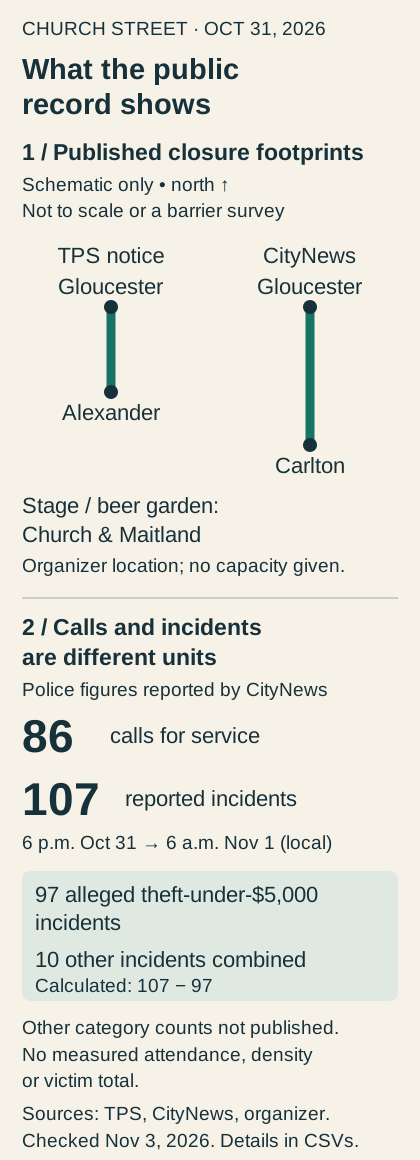
The schematic compares published descriptions; it is not a surveyed map, evacuation guide or reconstruction of barriers. Download the incident dataset and footprint source comparison. Blank category counts mean unpublished, not zero.
The closure descriptions do not match
The Toronto Police Service’s October 30 notice named Church Street between Gloucester and Alexander streets, plus Wellesley Street East near Church. Its scheduled closure ran from 5 p.m. October 31 to 7 a.m. November 1. CityNews describes a longer Church Street closure extending south to Carlton. These are different published endpoints; the available documents do not settle exactly where barriers stood throughout the night.
The organizer’s event page places the beer garden and stage at Church and Maitland. It advertised two evenings, October 30 and 31, with Saturday’s stage and garden hours running from 5 p.m. to midnight. Those programme hours should not be substituted for the road-closure hours. Nor does a named attraction establish the capacity of the surrounding street.
For an event review, reconciling the maps would be a practical first task. A usable retrospective plan would distinguish the approved closure, the barriers actually installed, the space occupied by event equipment, and the routes kept clear for emergency access. Without those details, a line between two intersections cannot establish usable pedestrian space.
Read the incident categories without filling in the blanks
Subtracting 97 from 107 leaves 10 incidents in the other reported categories combined. The categories named in the report include lost property, a driving complaint, vehicle mischief, trespassing, assault causing bodily harm and sexual assault. Individual counts were not published. The dataset preserves those missing values instead of allocating the remainder among categories. CityNews
That remainder cannot be relabelled “10 assaults.” Equally, a blank beside sexual assault cannot be read as zero. The published breakdown does not provide the number of affected people, whether multiple reports concern the same person, or the eventual investigative outcomes. It therefore cannot support a victim total or a comparison of confirmed offences.
A useful next release would state the reporting cutoff, the geographic area covered, category totals and whether later reports changed the figures. Keeping those definitions stable would make a future year-to-year comparison meaningful. Merely placing two headline totals next to each other would not.
Why there is no crowd-density figure here
Police anticipated more than 80,000 people over the evening before the event. That was a forecast, not an observed attendance count. Their notice also anticipated substantial pedestrian congestion. Police event notice
Dividing the incident total by that forecast would produce a misleading attendee rate. Calculating density would require an observed number of people in a defined usable area at a specified time. None of those measurements is supplied by the sources used here.
The evidence card consequently leaves attendance, density and victim totals unmeasured. It makes no finding that a crowd crush occurred. The purpose is to give the eventual review a checkable starting point: which space was available, what police counted, and which important questions remain unanswered.