
Choose Your Niagara Falls Window by What You Want to See and Do
September balances a first trip; summer is safer for boat tours and outdoor attractions, while October favors foliage and photography.
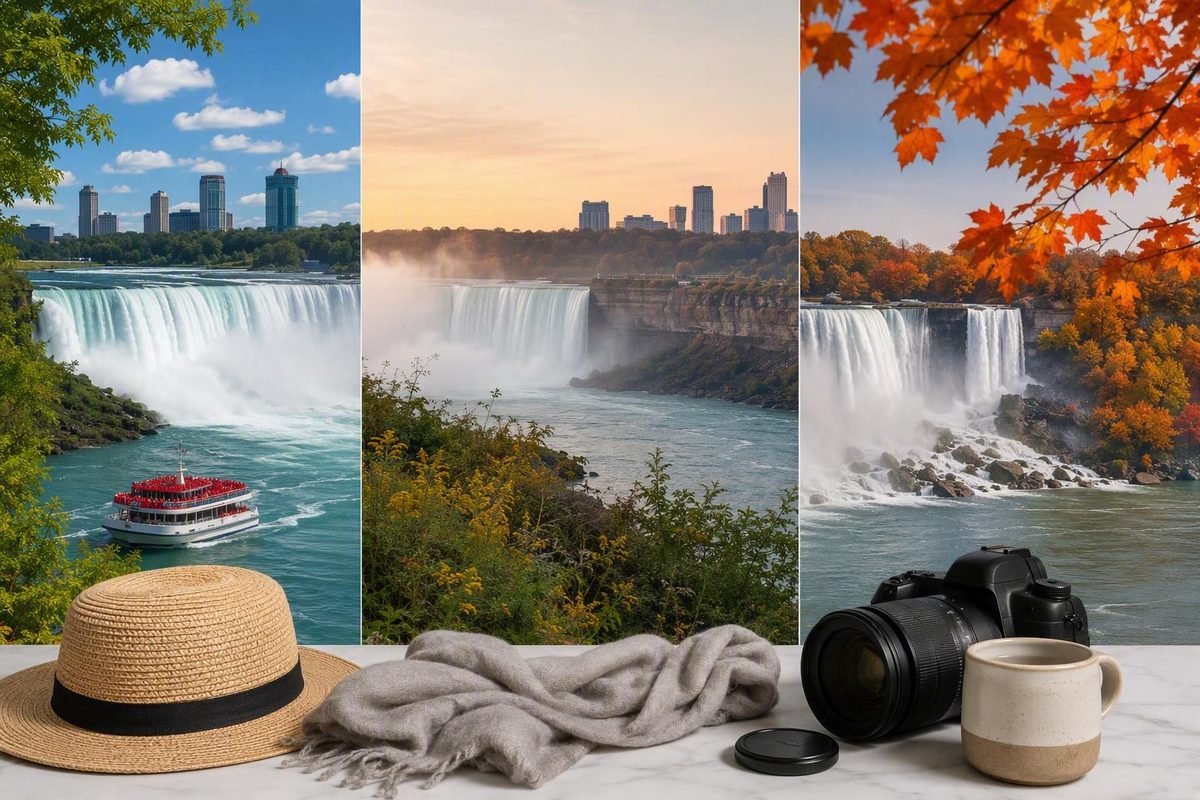
For most first-time visitors, September is the best time to visit Niagara Falls for overall balance. Many seasonal attractions generally remain available after the busiest summer period begins to ease. That is an editorial recommendation, not an official finding or a promise of warm, dry weather.
Choose June through August if maximum attraction access matters most, mid-to-late October for fall foliage, winter for a quieter scenic trip, or May for spring flowers and lighter crowds.
The short answer: choose the season that matches your priority
There is no universally best month. The right window depends on whether you care most about outdoor attraction access, smaller crowds, seasonal scenery, comfortable weather, or the possibility of finding lower room rates.
| Your priority | Best window | Why it works | Main trade-off |
|---|---|---|---|
| Best overall balance | September, especially weekdays after Labor Day | Seasonal attractions often continue operating as summer demand eases | Weather and attraction access are not guaranteed |
| Widest attraction access | June through August | Broad schedules and the fullest choice of outdoor activities | Peak crowds, heat, humidity, lines, and higher room rates |
| Fall foliage | Mid-to-late October | The strongest general window for autumn colour | Peak colour varies, and some attractions reduce hours |
| Quiet winter scenery | Winter | Fewer visitors, illumination, and possible snowy or icy views | Cold weather and seasonal closures |
| Spring flowers and lighter crowds | May | More established greenery and blooms than early spring | Variable weather; operators follow separate reopening schedules |
Keep two questions separate:
- When will the landscape look the way you want?
- Will your two or three priority attractions operate on those dates?
A winter visit may provide dramatic scenery without a boat tour. A summer visit may offer the broadest access without the quiet viewpoint you imagined. If cost matters most, compare rates for your exact dates rather than assuming one season will always be cheapest.
For a straightforward first trip, September is the compromise choice. For a trip built around boat tours and outdoor attractions, summer is safer. For photography and foliage, October may be worth accepting shorter operating hours.
June through August: best for the fullest attraction experience
Summer is worth the crowds when the purpose of the trip is to experience the widest possible range of outdoor attractions. Longer operating days also make it easier to combine a boat experience, viewpoints, walking routes, and an evening return to the illuminated Falls.
The official Niagara Falls USA seasonal guide identifies summer as peak season and says its major attractions are open, highlighting U.S.-side experiences such as Maid of the Mist and Cave of the Winds. That guidance applies to the U.S. side; it does not guarantee that every attraction in both countries will operate throughout your stay. Individual opening dates, weather interruptions, maintenance, and capacity limits can still affect plans. See Niagara Falls USA’s seasonal guide.
The trade-offs are peak-season crowds, heat, humidity, longer lines, higher room rates, and competition for timed admission. An attraction can be operating while its most useful time slots are already unavailable. Reserve the experience that defines the trip first—often a boat tour or another timed attraction—then arrange meals, viewpoints, and secondary stops around it.
If you are staying overnight, reserve accommodation early. U.S. News characterizes June through August as the period with peak crowds and rates and recommends booking summer lodging two to three months ahead. That lead time is guidance, not a guarantee of availability or price. Review the U.S. News seasonal comparison.
Summer is therefore the safest seasonal choice for access, but not necessarily for ease. Keep the day readable:
- Reserve the highest-priority timed attraction first.
- Put the most important outdoor stop early in the day.
- Leave buffer time for queues and walking between areas.
- Do not build a Toronto return around an unrealistically tight final connection.
- If you can stay overnight, use the evening and early morning for less compressed sightseeing.
September and October: the strongest shoulder-season choices
Weekdays after Labor Day in September offer the strongest overall compromise. The local-perspective guide sightDOING ranks September first because attractions generally continue operating while crowds ease after summer. That ranking is the publication’s subjective judgment, and its weather observations should not be treated as a forecast. The access-versus-crowds logic nevertheless makes September a sensible editorial choice for many first visits. Read sightDOING’s seasonal assessment.
Choose between September and October according to what you are least willing to sacrifice:
- Choose September if boat tours, outdoor attractions, and longer operating schedules matter more than autumn colour.
- Choose October if cooler conditions and fall scenery matter more and you can tolerate reduced hours or a seasonal closure.
- Choose mid-to-late October if foliage is the central reason for the trip.
Niagara Falls USA says fall colour usually peaks in mid-to-late October, although weather can shift the timing each year. Treat that as a general planning window rather than a promise for a specific weekend. Check the official U.S.-side seasonal guidance.
Later October requires more operational checking. Some attractions may shorten their hours as the month progresses, and seasonal services can end on different dates depending on the operator and side of the border. “Open in fall” does not necessarily mean open every weekday or into the evening.
Early October also has a calendar exception. Canadian Thanksgiving may bring different Canadian-side crowd patterns, closures, or attraction and restaurant hours. U.S. News specifically flags the holiday as a period when Canadian-side closures may occur, so check individual operators if your visit falls around the holiday.
September and October work particularly well for an overnight trip. Put the most schedule-sensitive attraction on the first available day, then use the second for viewpoints, walking, gardens, or weather-dependent foliage stops. That structure is more resilient than arriving from Toronto with every activity locked into a single afternoon.
Winter and spring: quieter trips with more operational uncertainty
Winter suits visitors who prioritize fewer crowds, possible lodging discounts, nighttime illumination, and snowy or icy scenery over full access to outdoor attractions. It is not the safest season for a first trip centred on boat experiences.
Freezing conditions can close seasonal tours, including boat services. U.S. News notes that many attractions and tours shut down during freezing winter conditions and that lodging may be discounted compared with peak periods. Neither the closures nor the prices will be identical on every date, so build the trip around a small number of reliable sights and keep an indoor alternative nearby.
Ice formations may appear around the Falls during cold periods, but they are weather-dependent. Do not choose a fixed date on the assumption that the landscape will look frozen.
Niagara Parks lists Falls illumination every evening throughout the year. Fireworks are different: they run during a defined season rather than nightly year-round. Verify the current event calendar before planning a late return around either experience. Check current Niagara Parks event information.
Spring is transitional. Flowers and greenery return, crowds can be lighter than in summer, and outdoor walking becomes more appealing. Cold conditions and snow can nevertheless persist into April, while attractions reopen according to their own calendars rather than all at once.
For a spring-focused trip, May is a stronger choice than March or early April. It offers a better chance of established greenery, flowers, and milder conditions without guaranteeing any of them. If a boat tour or another seasonal attraction is essential, its operator’s calendar should determine the final date.
A flexible winter or spring day needs only four parts:
- one priority viewpoint or attraction;
- one indoor backup;
- one flexible meal or walking block;
- enough time to adjust for weather or transportation delays.
Check the Canadian and U.S. sides separately
Niagara Falls is one geographic destination, but its visitor services do not operate as one system. The Canadian and U.S. sides have different attraction operators, ticket products, transportation networks, reservation rules, and seasonal calendars.
On the U.S. side, examples such as Maid of the Mist and Cave of the Winds should be checked through their operators or Niagara Falls USA. On the Canadian side, Niagara Parks information applies to its own attractions, passes, WEGO arrangements, and related transportation products. A Canadian pass does not establish access to a U.S. attraction, and a U.S. seasonal guide does not confirm a Canadian operator’s dates.
These are product-specific 2026 windows, not opening dates for every attraction or schedules that should be assumed in another year. Niagara Parks also warns that preferred peak-season timed-admission slots are not guaranteed. Check the exact Niagara Parks pass and transportation terms.
For the side you plan to visit, confirm:
- Boat-tour operating dates.
- Hours for each priority attraction.
- Pass validity on the exact visit date.
- Whether timed admission is required and still available.
If you intend to visit both sides, treat the crossing as a separate route decision rather than as another quick stop between adjacent attractions.
Planning a car-free Niagara Falls trip from Toronto
A car-free trip from Toronto is possible throughout the year. GO Transit advertises year-round weekday and weekend service between Toronto and Niagara Falls. Year-round regional service does not mean every journey is direct, every local shuttle operates, or every attraction is open.
When a direct Niagara GO train is unavailable, GO identifies an alternative route: take the Lakeshore West train to Burlington, then transfer to Route 12 for the Niagara Falls Bus Terminal. That transfer changes the shape of a day trip, so examine the complete outbound and return timetable rather than looking only at the first departure. Construction and planned track work can also affect service. Use GO Transit’s current Toronto–Niagara guidance.
GO+WEGO combination tickets can bundle regional travel with local WEGO access. Prices and inclusions can change, so compare the current package with separate fares and confirm how long its local component remains valid.
Do not confuse the year-round base network with seasonal extras. Summer weekend bike coaches are seasonal, and some Niagara-on-the-Lake connections operate only within limited windows. WEGO coverage and frequency may also differ from the attraction list you have built.
For a same-day trip, check:
- whether the outbound and return journeys are direct;
- transfer time at Burlington, if required;
- the last practical return, not merely the final scheduled departure;
- WEGO stops and frequency near your priority attractions;
- construction or service-change notices;
- seasonal connections beyond the central Falls area.
A day trip works best when the route stays compact. Choose two or three central attractions instead of trying to combine the Falls, Niagara-on-the-Lake, both sides of the border, and a late Toronto return.
A five-minute check before you book
Seasonal advice can narrow the choice, but use this checklist before committing to an exact date:
- Weather forecast: Check close to departure for wind, freezing conditions, thunderstorms, or heavy rain.
- Attraction dates and hours: Confirm every essential stop with its operator.
- Timed admission: Make sure useful slots remain before purchasing transport.
- Pass validity: Read the dates on the exact product, not a general destination page.
- Fireworks calendar: Do not confuse year-round illumination with seasonal fireworks.
- GO and WEGO schedules: Check direct service, transfers, local coverage, and the return journey.
- Construction notices: Review track work, road restrictions, and service changes.
- Holiday dates: Account for Canadian and U.S. holidays that may affect crowds, closures, or hours.
For historical Canadian weather context, use Environment and Climate Change Canada’s Canadian Climate Normals portal. Select an appropriate Niagara-area station and dataset before using the monthly averages; the general portal does not establish Niagara Falls-specific figures until those selections are made. Historical hourly, daily, and monthly records are also available through the department’s weather-data tools.
Annual conditions can shift foliage timing and ice formation, while attraction calendars and transit details can change independently. The final routing rule is simple: choose the date only after confirming that the two or three attractions central to your trip will be operating.