
Choose Thai Curry by Flavor, Not by Color Alone
Green is commonly brighter and more herbal, while red is commonly deeper and more chili-led. Recipe and restaurant practice matter more than color for heat.
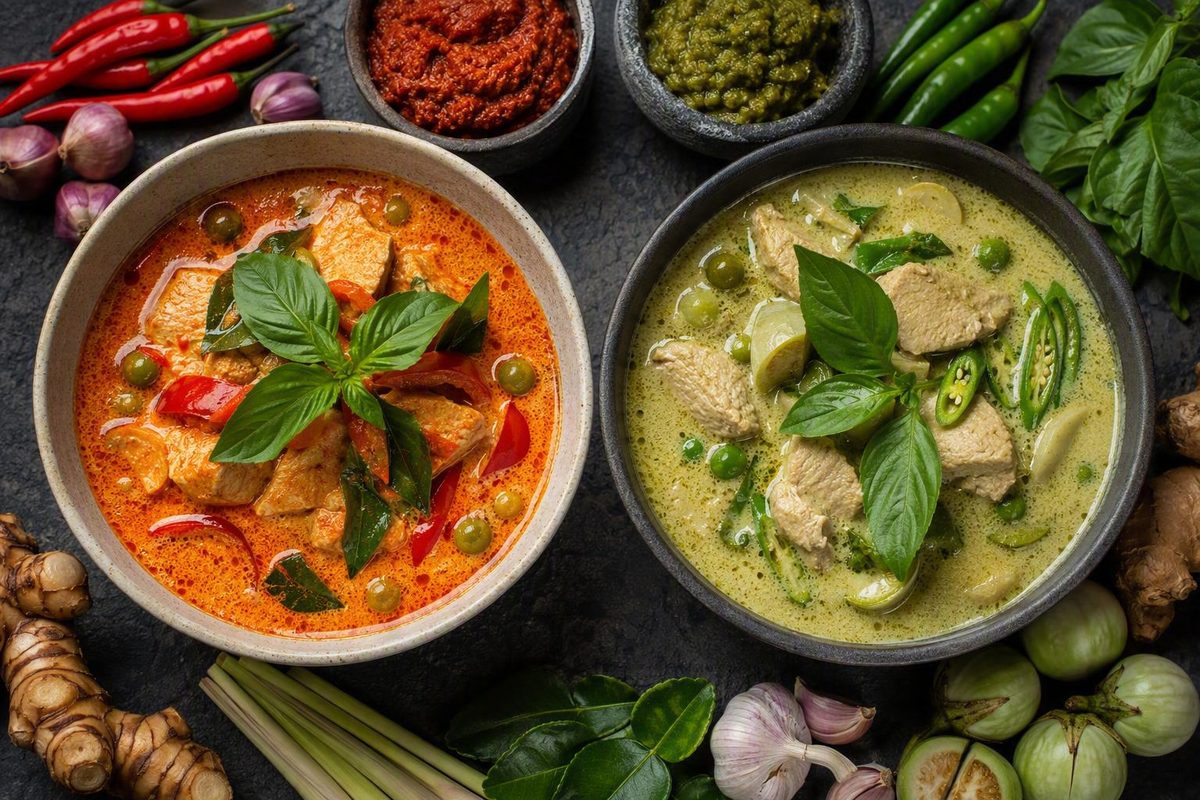
The main difference between red and green curry begins with the curry paste: red curry generally uses red chilies, while green curry generally uses fresh green chilies. Those chilies influence the color, aroma, and flavor direction of the finished dish.
Green curry is commonly described as fresh, bright, and herbaceous. These are useful tendencies, not fixed definitions—and color does not provide a dependable heat ranking.
The most practical way to choose is:
- Pick the flavor profile you want: green for herbal freshness or red for deeper chili character.
- Check or adjust the heat of that particular preparation separately.
Red Curry vs. Green Curry at a Glance
Thai red and green curries often share a basic structure. Both may combine chilies with pungent aromatics, savory seasonings, and coconut milk. The clearest distinction is usually the color and type of chili used in the paste, together with the flavor profile built around it.
Commercial cooking guides commonly characterize green curry as fresh and herbaceous, while describing red curry as bolder and more centered on red-chili flavor. Their representative ingredient lists also overlap substantially, which is why the difference is more nuanced than two completely unrelated curry styles (Formosa Asian Market’s curry comparison).
| Feature | Red curry | Green curry |
|---|---|---|
| Defining chilies | Commonly red chilies, which may be dried or fresh depending on the recipe | Commonly fresh green chilies |
| Color | Red, rust-red, or orange-red, principally influenced by the red chilies | Green to pale green, principally influenced by fresh green chilies |
| General flavor | Commonly deeper, rounder, bolder, and more chili-forward | Commonly brighter, fresher, and more herbaceous |
| Commonly listed aromatics | Lemongrass, galangal, garlic, shallots, coriander, and makrut lime leaves, zest, or peel, depending on the recipe | Lemongrass, galangal, garlic, shallots, basil, coriander or cilantro, and makrut lime leaves, zest, or peel, depending on the recipe |
| Heat variability | Can range from relatively gentle to very hot | Can range from relatively gentle to very hot |
| Suggested foods | Seafood, vegetables, chicken, pork, beef, duck, and other richer meats | Chicken, tofu, seafood, eggplant, and other vegetables |
The ingredients and pairings in the table are common examples, not mandatory components. Different restaurants, home cooks, and commercial producers use different combinations and proportions. An ingredient associated with one curry should not automatically be treated as universal.
The decision shortcut is simple:
- Choose green curry if you want fresh-chili and herbal aromas to lead.
- Choose red curry if you want a deeper, more concentrated red-chili character.
- Ask about heat separately, because neither choice guarantees a particular spice level.
What Gives Each Curry Its Color and Character?
The chilies in the paste provide the clearest visual distinction. Red chilies give red curry its characteristic color, while fresh green chilies supply green curry’s primary green cue. Herbs may reinforce green curry’s appearance and aroma, but the defining distinction reported across the supplied comparisons is the use of green rather than red chilies.
Red curry: red chilies with a deeper flavor direction
Red-curry paste may be described as using dried or fresh red chilies, depending on the source and preparation.
My Thai Curry, a commercial curry-paste producer, describes soaked dried red chilies as the traditional basis of red-curry paste. Its account says soaking permits a concentrated chili flavor with less harshness and heat. That is the producer’s culinary explanation, not a controlled finding about capsaicin or a rule that applies to every red curry (My Thai Curry’s discussion of curry heat).
Another commercial food-brand account describes red-curry paste made with fresh red chilies and notes that some recipes use chili powder to deepen the color. These conflicting descriptions do not establish one exclusive formula. They show that documented commercial recipe accounts differ in the form and preparation of the red chilies.
The finished character also depends on more than the chilies.
Green curry: fresh green chilies and herbal aromatics
Fresh green chilies provide green curry’s defining color cue and fresh-chili profile. Basil, coriander or cilantro, and makrut lime are also frequently listed as contributors to its herbal character.
One Thai food manufacturer, for example, presents a green-curry preparation containing green chilies, cilantro, basil, makrut lime leaves, garlic, lemongrass, ginger, fish sauce, and coconut milk. Its red-curry description instead emphasizes red chilies alongside ingredients such as garlic, shrimp paste, and galangal (Exotic Food’s guide to Thai curry types).
These are representative commercial ingredient lists, not authoritative formulas for every regional, restaurant, or homemade curry. Basil, coriander, and makrut lime are frequently reported in green curry, but the supplied sources do not establish that every preparation contains all of them.
It is also useful to distinguish different makrut lime ingredients:
- Makrut lime leaves may be used for their distinctive fragrance.
- Makrut lime zest or peel comes from the fruit’s exterior and may be incorporated into a paste.
Shared foundations
Red and green curry pastes may share aromatics such as:
- Lemongrass
- Galangal
- Garlic
- Shallots
- Coriander or cilantro components
- Makrut lime leaves, zest, or peel, depending on the recipe
Representative recipes may also include shrimp paste, fish sauce, or other savory ingredients.
The chili color establishes the clearest family resemblance. The surrounding ingredients determine how each individual curry expresses that identity.
How Red and Green Curry Differ in Flavor
Red and green curry have substantial flavor overlap. Commercial comparisons commonly present both as aromatic, savory, spicy, and somewhat sweet. Either may combine chili heat with fragrant herbs, pungent roots and alliums, salty or fermented seasonings, and a rich sauce.
The main distinction is which qualities tend to lead.
Green curry commonly leads with fresh, herbal notes
Green curry is commonly associated with a brighter aromatic impression. Fresh green chilies establish its base, while basil, coriander or cilantro, lemongrass, and makrut lime may contribute a vivid herbal profile.
“Herbaceous” does not mean bland or mild. A curry can smell fresh and leafy while still delivering considerable chili heat.
Green curry may be the better choice if you want:
- Fresh green-chili aroma
- Fragrant herbal notes
- Makrut lime fragrance
- A vivid, lifted aromatic profile
These are tendencies rather than standardized results. The specific paste, chili quantity, aromatics, and cooking method can shift the balance considerably.
Red curry commonly lets the chili character lead
Red curry is often described as bolder, deeper, and more rounded, with the red chili taking a more prominent role. “Chili-forward” refers to flavor emphasis; it does not necessarily mean the curry produces more heat.
Common sensory cues include:
- A fuller red-chili flavor
- A deeper aromatic impression
- A rounder overall profile
- Less emphasis on fresh green herbs
A commercial comparison from Cottage Delight describes red curry as hotter and more intensely chili-forward while calling green curry milder and more herbaceous. The same account acknowledges that ingredients and heat can be changed by the cook, so its sweetness and heat descriptions should be treated as one producer’s generalization rather than a universal rule (Cottage Delight’s red and green curry comparison).
Sweetness and mildness are weak identifiers
Some guides describe green curry as milder or sweeter than red curry. Others describe green curry as the hotter choice. Because the supplied accounts conflict, neither sweetness nor mildness is a dependable way to identify the two curries.
The amount of sugar, coconut milk, salty seasoning, paste, and chili can alter the balance. A green curry may be fiery and only gently sweet. A red curry may be coconut-rich and rounded without being particularly hot.
For flavor alone, choose green when vivid herbs sound most appealing and red when you want red chili to play the leading role. Treat the heat level as a separate question.
Which Is Hotter: Red Curry or Green Curry?
Neither curry is universally hotter. Color alone is not a reliable guide to spice.
The supplied cooking sources disagree about the usual ranking. My Thai Curry and Marion’s Kitchen generally characterize green curry as hotter. Formosa Asian Market, Cottage Delight, and Exotic Food characterize red curry as hotter or more intense.
Marion’s Kitchen, for example, describes red curry as generally medium-hot and green curry as spicier, while also stating that heat varies with the recipe, region, and quantity of chilies used (Marion’s Kitchen’s guide to Thai curries).
None of these commercial sources provides standardized red and green recipes, controlled side-by-side measurements, or capsaicin testing. Their descriptions can illustrate culinary tendencies or producer practices, but they cannot establish a universal winner.
Why some accounts call green curry hotter
My Thai Curry describes traditional green curry as hotter than traditional red curry. It also says southern Thai green curries may be especially fiery when bird’s-eye chilies are used.
In that producer’s explanation, soaked dried red chilies allow red-curry paste to carry concentrated chili flavor without necessarily matching the heat of a green curry made with very hot fresh chilies. This remains an experience-based culinary account rather than a tested rule.
A restaurant or home recipe can readily produce the opposite result by using hotter red chilies, more red-curry paste, or fewer green chilies.
Why other accounts call red curry hotter
Other commercial guides associate red curry with stronger heat as well as bolder red-chili flavor. That may accurately describe their recipes, products, or familiar restaurant preparations, but it does not show that red chilies are automatically hotter than green ones.
Conversely, a bright and herbal green curry may be extremely hot even if its flavor seems fresher.
The variables that matter more than color
Relative heat can change with:
- Chili variety: Different red and green chilies can produce different levels of heat.
- Chili quantity: The amount used matters regardless of color.
- Paste strength and quantity: Recipes and commercial pastes need not have the same concentration.
- Regional approach: Different preparations may use different chilies and balances.
- Individual recipe: Two cooks can make the same named curry differently.
- Restaurant practice: A kitchen may prepare its red and green curries at different baseline heat levels.
- Requested spice level: A customized “hot” dish may be considerably spicier than a “mild” version of the other curry.
My Thai Curry also reports that some restaurants outside Thailand customize heat by adding chopped chilies or chili powder after the diner selects a spice level. That practice can reverse any expected ranking between red and green curry.
When ordering, ask:
- Which curry is hotter in this kitchen?
- What do mild, medium, and hot mean here?
- Is most of the heat already in the paste?
- Can the spice level be adjusted?
The evidence supports no universal red-versus-green heat ranking. The actual chilies and preparation are more informative than the finished color.
The Role of Coconut Milk and Other Recipe Choices
Both red and green curries are often prepared with coconut milk, but the supplied sources do not establish coconut milk as a universal ingredient in every regional, restaurant, or homemade version.
Commercial cooking accounts describe coconut milk as softening perceived heat. That does not mean it removes chili or creates a predictable spice level. A coconut-rich curry may taste rounder while still containing a substantial amount of hot chili.
Three related qualities should be kept separate:
- Chili content concerns the amount and type of chili used.
- Perceived heat concerns how forcefully the heat registers in the completed dish.
- Richness concerns the body and rounded character associated with ingredients such as coconut milk.
These qualities interact, but they are not interchangeable. Richness does not guarantee mildness, and neither curry color guarantees a particular level of coconut flavor, sweetness, saltiness, or thickness.
How home cooks can reduce the heat
The supported adjustments are straightforward:
- Use fewer added chilies.
- Reduce the amount of chili used in a homemade paste.
- Reduce or omit extra chilies called for during cooking.
- Use coconut milk to soften the way the heat is perceived.
Make adjustments gradually. Adding large quantities of liquid solely to dilute the curry may also dilute the lemongrass, galangal, makrut lime, herbs, and other aromatics. Starting with fewer chilies is generally a more controlled approach than trying to thin an excessively hot finished sauce.
The supplied evidence does not establish a reliable brand-wide rule for adjusting them, so follow the product instructions and make small changes based on the specific paste being used.
Richness is not the same as mildness
A rich coconut sauce can remain spicy. A curry with less coconut milk can still be mild if it contains fewer or gentler chilies.
The same distinction applies to sweetness. A round, slightly sweet sauce may soften the overall impression of a curry without changing how much chili went into it. Neither red nor green curry has one fixed balance that every cook must reproduce.
Which Curry Should You Order?
Choose between red and green curry by answering two separate questions:
- Which flavor profile sounds better?
- How hot is that restaurant’s version?
First question: Which flavor profile sounds better?
Order green curry if you are drawn to:
- Fresh green-chili aroma
- Basil, coriander or cilantro, and other herbal notes
- Makrut lime fragrance
- A bright, vivid aromatic profile
Order red curry if you prefer:
- A deeper red-chili character
- A bolder, rounder flavor
- Less emphasis on fresh green herbs
- A sauce in which chili flavor appears to lead
These recommendations remain conditional. A restaurant’s recipe may emphasize different aromatics, levels of richness, or seasoning balances.
Second question: How hot is that restaurant’s version?
Do not let the flavor choice answer the heat question. A kitchen may make green curry hotter, red curry hotter, or both at a similar level. It may also customize each dish independently.
A concise restaurant checklist is:
- Which curry is hotter in your kitchen?
- Can the spice level be adjusted?
- Is the heat already built into the paste?
- Does the dish contain coconut milk?
- Does it contain fish sauce, shrimp paste, or anything else relevant to my dietary needs?
Visible tofu or vegetables do not reveal every ingredient in the paste or sauce. Representative recipes may contain fish sauce or shrimp paste, so ask the restaurant when those ingredients matter to you.
Suggested food matches
Green curry is commonly suggested with:
- Chicken
- Tofu
- Seafood
- Eggplant and other vegetables
Red curry is commonly suggested with:
- Seafood
- Vegetables
- Chicken
- Pork
- Beef
- Duck or other richer meats
These are serving suggestions, not requirements. Chicken, seafood, and vegetables are commonly listed with both styles. The additions do not determine the curry’s identity, and the restaurant’s available combinations may differ.
If both curries are offered with your preferred protein or vegetables, focus on the sauce: choose green for herbal freshness or red for deeper red-chili flavor, then confirm the heat level.
Common Myths and the Limits of Simple Curry Rules
Color is helpful for recognizing the broad type of paste, but it becomes misleading when treated as a complete guide to the dish.
Myth: Red means hotter
Red indicates the use of red chilies. It does not disclose the chili variety, quantity, paste strength, or requested restaurant spice level.
A vividly red curry may be moderate, while a green curry may be extremely hot. Color suggests flavor direction; it does not measure heat.
Myth: Green curry is always hotter
Some commercial cooking sources describe traditional green curry as hotter, particularly when very hot green chilies are used. That is a qualified tendency reported by those sources, not a rule for every region, restaurant, home recipe, or packaged paste.
Green curry’s fresh and herbal identity does not guarantee mildness, but it does not guarantee greater heat either.
Myth: There is one definitive ingredient list
The supplied commercial comparisons present overlapping but different ingredient lists. Commonly reported ingredients include lemongrass, galangal, garlic, shallots, makrut lime, basil, coriander, shrimp paste, fish sauce, and coconut milk, but no supplied source establishes that every curry contains all of them.
Precision also matters within those lists. Makrut lime leaves are not the same ingredient as makrut lime zest or peel. Broad summaries should not erase distinctions between plant parts or suggest that they are interchangeable.
Myth: All red curry uses the same kind of red chili
The sources conflict directly. My Thai Curry describes soaked dried red chilies as the traditional basis for red-curry paste, while Cottage Delight describes fresh red chilies and notes that chili powder may be used for deeper color.
Because both are commercial culinary accounts rather than independent definitions, neither should be treated as establishing the exclusive formula for red curry. The narrower supported conclusion is that red chilies define the broad color family while their form and preparation vary among the documented examples.
Myth: A fresh, herbal curry must be gentle
Freshness and heat describe different qualities. Green chilies and herbs can create a bright aroma without neutralizing chili heat. Green curry can therefore be both herbal and hot.
The reverse is also true: red curry’s deeper, rounder character does not prove that it contains more or less heat.
What the evidence can—and cannot—tell us
The supplied comparisons come from curry-paste producers, food retailers, manufacturers, and cooking businesses. They provide useful examples of ingredients, flavor descriptions, pairings, and producer practices. They do not provide standardized recipes, controlled heat measurements, or independent evidence capable of settling every question about traditional preparation.
That limitation is especially important because the sources disagree about which curry is hotter and whether red curry is typically made with dried or fresh chilies. Those disagreements should not be flattened into a false universal rule.
The most reliable conclusion is therefore limited but useful: chili color helps identify the paste and its likely flavor direction, while the individual recipe determines the finished dish. Green curry is commonly the brighter, more herbal option; red curry is commonly the deeper, more chili-led option. Region, paste, chili quantity, recipe, and restaurant practice matter more than color when predicting heat.
Frequently Asked Questions
Is red curry or green curry hotter?
Neither is universally hotter. The supplied commercial cooking sources disagree: some describe green curry as hotter, while others rank red curry as hotter or more intense.
Chili variety, quantity, paste strength, recipe, region, cook, and restaurant customization determine the result. Ask about the specific preparation rather than choosing by color.
Why is green curry green?
Green curry gets its defining color primarily from fresh green chilies. Herbs such as basil and coriander or cilantro may reinforce its green appearance and herbal aroma, but the representative ingredient lists vary.
Do red and green curry both contain coconut milk?
Both are often prepared with coconut milk, but it should not be assumed that every version contains it. Ask the restaurant or check the recipe when coconut milk matters for a dietary need or personal preference.
How can I make red or green curry less spicy?
Use fewer added chilies, reduce the chili in a homemade paste, or omit extra chilies during cooking. Coconut milk can soften perceived heat, although it does not remove chili already present.
Adjust gradually so the curry’s other aromatics are not diluted.
Which curry is better with chicken, tofu, seafood, or vegetables?
Green curry is commonly paired with chicken, tofu, seafood, and vegetables. Red curry is also commonly paired with chicken, seafood, and vegetables, as well as pork, beef, duck, and other richer meats.
These are flexible suggestions. Choose green for a commonly fresher, more herbal profile or red for a commonly deeper, chili-led profile, then verify the heat separately.