
Which Espresso Roast Fits the Drink You Actually Want?
Blonde is typically brighter, lighter-bodied and less bitter. "Regular" is the café's default coffee. Caffeine depends on dose, blend and shot count.
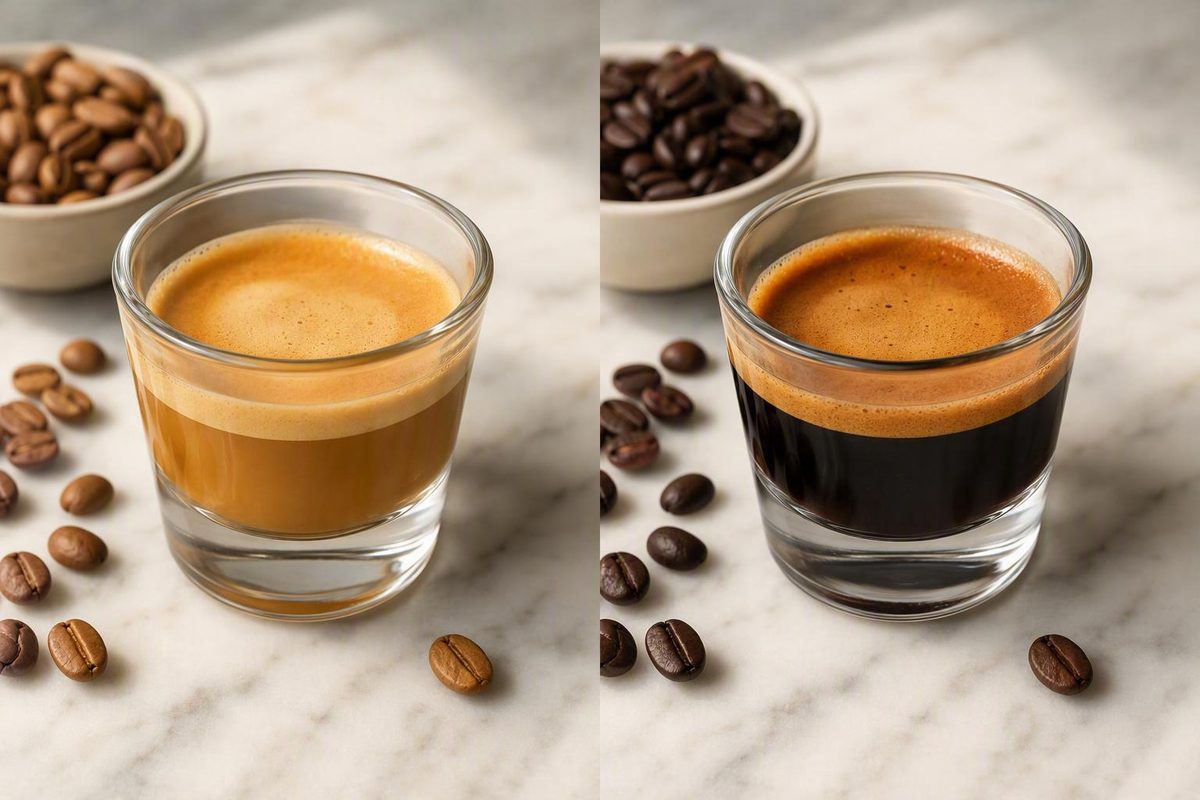
The short answer: how blonde and regular espresso differ
Espresso describes a pressure-based way of preparing coffee. Blonde describes the relatively light roast used for that preparation. Blonde espresso is therefore not a separate brewing method: it is espresso made with lighter-roasted coffee.
“Regular espresso” is less precise. It usually means a café’s default espresso blend, often roasted medium to dark. At some specialty cafés, however, the house espresso may itself be relatively light. When ordering from an unfamiliar menu, the café’s flavor description is more useful than the word regular.
| Attribute | Blonde espresso tendency | Regular espresso tendency |
|---|---|---|
| Typical roast | Light or medium-light | Café’s default; often medium to dark |
| Bean color | Lighter brown, usually with little surface oil | Darker brown; dark roasts may look oily |
| Flavor | Citrus, berry, fruit, floral or delicate sweetness | Chocolate, caramel, nuts or deeper roasted flavors |
| Sensory acidity | More prominent and vivid | Usually softer or less prominent |
| Bitterness | Usually lower | Usually higher, especially with darker roasting |
| Body | Lighter, cleaner or more tea-like | Fuller, heavier or more syrupy |
| Finish | Crisp, clear or relatively quick | Lingering, roasty or heavier |
| Caffeine | Cannot be predicted from the label alone | Cannot be predicted from the label alone |
| Equipment | A capable espresso machine | The same type of machine |
| Extraction behavior | May require more careful adjustment | Often easier to balance with a conventional recipe |
These are tendencies, not guarantees. Roaster comparisons commonly associate blonde espresso with brighter acidity, lighter body and less bitterness, while associating darker espresso with fuller body and chocolate, caramel or nut-like notes. The coffee and preparation still influence the result alongside roast level (Twisted Goat Coffee’s comparison).
A medium roast may taste remarkably bright. A poorly extracted blonde shot may taste harsh or sharply sour rather than delicate. A well-made dark roast can be balanced and sweet rather than smoky or burnt.
The practical choice is mainly about flavor. Choose blonde when you want clarity, fruit or floral character and less roast bitterness. Choose the house espresso when you want more body and deeper roasted flavors. Neither is automatically stronger, better or higher quality.
What “blonde” and “regular” actually mean
Blonde espresso is ordinary espresso prepared with lightly roasted coffee. It is not a predefined drink containing milk, syrup or sugar.
Espresso also does not require dark-roasted beans. Suitable light-, medium- and dark-roasted coffees can all be brewed as espresso. Roast level changes the flavors available in the cup and may affect how a barista approaches extraction, but it does not change the fundamental preparation category.
The phrase regular espresso should be read operationally: it means whatever coffee a particular café uses by default. That could be a dark blend intended to remain assertive in milk, a balanced medium roast or a relatively light specialty blend. If a menu offers “blonde” and “signature” espresso, the distinction belongs to that business’s particular coffees.
Roast terminology is not governed by universal thresholds. One roaster’s blonde may resemble another roaster’s light-medium coffee. Labels such as light, medium-dark, dark and espresso roast communicate a general direction rather than a standardized specification. Even guides that provide approximate roasting milestones acknowledge that classifications vary with the coffee and roasting equipment (1Zpresso’s light-roast espresso guide).
For that reason, no exact roasting time, final temperature or crack stage universally defines blonde espresso. Roast development changes with the green coffee, batch, machine and intended flavor profile.
Blonde espresso is also distinct from white coffee. White coffee is roasted much more lightly and is not simply another name for the light roasts normally sold as blonde espresso. The categories may differ substantially in flavor and preparation (OutIn’s blonde espresso overview).
The word blonde does not mean:
- decaffeinated;
- weak or diluted;
- vanilla-flavored;
- sweetened;
- made with milk;
- associated with one particular country of origin.
Coffee from any origin can be roasted lighter or darker. Read the café or roaster’s tasting description instead of trying to infer roast level from geography.
Taste comparison: brightness, bitterness, body, and finish
A well-made blonde espresso often presents citrus, berry, ripe-fruit or floral impressions. Its sensory acidity may feel lively, while its body can seem lighter or more transparent. The finish may be clean and crisp, allowing individual flavors to remain distinct.
A medium-to-dark house espresso commonly moves in another direction. Chocolate, caramel and roasted-nut impressions may become more prominent. The body can feel fuller, bitterness may be easier to detect, and the finish may linger with a heavier or more roasted character.
Blonde espresso can also taste sweeter without containing added sugar. Here, sweetness is a sensory impression. An unsweetened blonde shot is still an unsweetened drink.
Sensory acidity is not the same as measured acidity
Coffee drinkers often use acidic to mean bright, tangy or sour. That describes a perceived flavor, not a laboratory measurement.
A blonde shot that tastes vividly citrus-like has prominent sensory acidity. That observation alone does not establish its pH or prove that it contains a particular quantity of acids. Roast comparisons do not establish that either style is definitively healthier or more suitable for the stomach (Colipse’s blonde-versus-regular overview).
Pleasant brightness should also be distinguished from extraction-related sourness. A balanced light-roast shot may suggest orange, berry or stone fruit while still tasting sweet and complete. An unbalanced shot may taste sharply sour, thin and unfinished.
The same distinction applies at the darker end of the range. Full-bodied or roasty does not automatically mean burnt. Smoke, ash or severe bitterness may reflect the coffee, roast development or extraction rather than an unavoidable property of standard espresso.
Roast is only one source of flavor
The final cup is shaped by interacting variables, including:
- coffee variety and growing conditions;
- processing method;
- blend composition;
- roast development;
- freshness and storage;
- grinder consistency;
- water;
- dry coffee dose;
- beverage yield;
- temperature and flow;
- barista technique.
Roast labels therefore predict a direction, not a guaranteed experience. A fruit-forward coffee roasted somewhat darker may retain brightness. A light-roasted coffee may taste soft and nutty rather than sharply fruity.
Crema should not be treated as a universal quality score. Taste the espresso rather than judging it only by its surface.
How to compare the two fairly
There are two useful tests, and they answer different questions.
For an identical-recipe comparison, use the same dry dose, beverage yield, water and cups.
For a best-dialed comparison, adjust each coffee independently until both taste balanced. This introduces more variables, but it provides the more useful answer to the question, “Which espresso do I actually prefer?”
For either test:
- Taste both shots warm rather than scalding hot.
- Record acidity, bitterness, sweetness, body, finish and clarity separately.
- Note whether either shot tastes hollow, sharply sour, harsh or drying.
- Repeat the comparison before drawing a firm conclusion.
Avoid reducing the result to “mild” versus “bold.” One shot may offer greater clarity and acidity but less body. The other may have greater roast intensity and bitterness but less fruit definition. Describing those dimensions separately makes the choice more meaningful.
Is blonde espresso stronger? Separate four meanings of strength
The word strong causes much of the confusion around blonde espresso versus regular espresso. It can refer to at least four different attributes.
1. Roasted-flavor intensity
A darker standard espresso often tastes stronger in the conventional sense. It may be heavier, more bitter and more overtly roasted. Dark chocolate, smoke or deep-caramel impressions can seem powerful, particularly in a straight shot.
Blonde espresso usually has less roasted intensity. Calling it lighter does not mean it is diluted. It means the roast contributes fewer dark or bitter flavor impressions.
2. Acidity and vividness
Blonde espresso can feel intense for a different reason. Prominent acidity, citrus character and fruit aromatics may seem sharp or immediate. Someone accustomed to dark espresso may interpret that vividness as strength even when the blonde shot has less body and roast bitterness.
Two apparently contradictory statements can therefore both make sense: regular espresso can taste bolder, while blonde espresso can taste brighter.
3. Beverage concentration
Concentration depends on the relationship between the dry coffee dose and the liquid espresso yield.
The labels blonde and regular do not specify either variable. Cafés can use different basket sizes, doses and shot recipes, so roast names alone reveal little about beverage concentration.
4. Caffeine dose
Caffeine cannot be inferred reliably from color, bitterness, body or perceived intensity. A mild-tasting drink may contain multiple shots, while a bitter-tasting drink may contain only one.
That comparison does not isolate roast level; it primarily demonstrates why serving recipe matters.
When ordering, translate “strong” into a specific preference:
- More roasted intensity: ask for the bolder house espresso.
- More brightness: ask for the lighter espresso.
- More concentration: ask how the shot is prepared.
- More caffeine: ask about the coffee dose, blend and number of shots.
Once the intended attribute is clear, the choice becomes much easier.
Caffeine: why the honest answer is “it depends”
Blonde espresso may contain slightly more caffeine in some comparisons, but roast level alone does not determine the caffeine in a served shot. The answer depends on what is being compared.
Equal dry coffee mass
If two shots use the same mass of coffee, roast color alone does not establish which one contains more caffeine. Bean species, blend and preparation remain relevant, and the available roast comparisons do not demonstrate a universal blonde advantage under fully controlled conditions.
That means “blonde always has more caffeine” is too broad. A small tendency reported for one coffee or measurement method should not be generalized to every café, blend or home recipe.
Equal bean or ground-coffee volume
A scoop-based comparison is not equivalent to a weight-based comparison. Roasting changes the physical characteristics of coffee, so equal volumes of two roasts may not contain equal masses.
Some equipment and roaster guides consequently limit a possible light-roast caffeine advantage to volume-based comparisons rather than presenting it as universal. Their practical advice is to weigh coffee when making a controlled comparison (1Zpresso’s discussion of roast and caffeine measurement).
The café’s actual finished drinks
This is the comparison that matters when ordering. Check:
- the coffee species or blend;
- the dry dose used for each shot;
- the number of shots;
- the café’s shot recipe;
- the drink size;
- any published caffeine information for that exact beverage.
Brand-specific figures should remain brand-specific. A number published for one chain’s blonde espresso cannot automatically be applied to an independent café, another chain or a home recipe.
Blend composition can also change the result. Commercial comparisons note that a darker blend containing Robusta may provide more caffeine than an all-Arabica blonde blend, illustrating why the roast label cannot settle the question by itself (Colipse’s discussion of blend and caffeine).
Boldness is not a caffeine meter. Dark-roast bitterness may make regular espresso seem more powerful, but taste intensity does not reveal the dose. Conversely, milk and syrup can conceal bitterness in a drink that still contains several shots.
A fair home comparison
A home tasting cannot determine precise caffeine content without analysis, but it can avoid obvious comparison errors:
- Use coffees with the same species composition, if known.
- Weigh equal dry doses instead of using scoops.
- Use the same number of shots.
- Target the same beverage yield.
- Keep the machine and water consistent.
- Do not generalize from one pair of coffees to every blonde and dark roast.
For everyday ordering, shot count and dose are more useful than roast color. If monitoring caffeine precisely matters to you, rely on information published for the specific beverage rather than on a generic claim about blonde espresso.
Which roast works best in straight shots, lattes, and iced drinks?
There is no universally best espresso roast for every drink. The useful question is which characteristics you want to remain noticeable after water, milk, ice or syrup is added.
| Drink | Blonde tendency | Regular tendency | Why |
|---|---|---|---|
| Straight espresso | Fruit, floral character, clarity and crisp acidity | Fuller body, chocolate, caramel, nuts and roast | Nothing masks the coffee, so the contrast is easiest to notice |
| Americano | Bright, clean and aromatic | Rounder, deeper and more roasty | Added water changes body while opening the drink |
| Small milk drink | Gentle, sweet-seeming and less bitter | Rich, chocolate-like and assertive | A modest amount of milk can suit either profile |
| Large latte | Soft and approachable, though delicate notes may fade | More likely to remain prominent through substantial milk | More milk can mute subtle flavor distinctions |
| Iced drink | Crisp when brightness is desired | Robust when body and roast flavor need to survive dilution | Cold temperature and melting ice can reduce aroma and texture |
| Flavored drink | Lower bitterness may complement sweet syrup | Roast character can provide more contrast | Strong flavoring can complement or obscure the espresso |
For a straight shot or Americano, consider blonde espresso when you want citrus, fruit, floral character, clarity or less roast bitterness. Choose the standard espresso when you prefer fuller mouthfeel, chocolate, caramel, nuts or a lingering roasted finish.
Milk drinks support two equally valid approaches. Blonde espresso can make a latte feel gentler and less bitter. A darker house espresso may remain easier to detect in a large amount of milk. The better choice depends on whether you want the coffee to integrate quietly or provide stronger contrast.
Syrups create the same tradeoff. Vanilla, caramel or fruit flavoring may work pleasantly with blonde espresso’s lower perceived bitterness. Strong sweetness can also hide the delicate fruit and floral qualities that made the light roast distinctive. A darker espresso may provide more counterweight in a heavily flavored drink.
Ice lowers the drink’s temperature and introduces dilution as it melts. Blonde espresso may suit someone seeking a bright, crisp iced Americano. Regular espresso may suit someone who wants a heavier coffee flavor to remain obvious through ice, milk or sweetener. Recommendations for blonde espresso in lattes, Americanos and iced drinks are best treated as preference-based pairings, not fixed rules (Jones’N Java’s blonde espresso guide).
Useful ordering questions include:
- “What does your house espresso taste like?”
- “Do you have a light-roast espresso option?”
- “Which one is fruitier, and which is more chocolate-forward?”
- “How many shots are included in this size?”
- “Which espresso works better with this milk?”
- “Will this syrup cover the lighter espresso?”
- “Do you publish caffeine information for this exact drink?”
The most informative experiment is to order both roasts in the same format. Comparing a blonde straight shot with a regular latte mainly compares two different drinks. Compare two shots, two Americanos or two otherwise identical lattes instead.
Brewing blonde espresso at home without buying special equipment
Blonde and regular espresso can be brewed with the same capable espresso machine. Blonde espresso does not inherently require a dedicated machine, grinder brand or accessory category.
Light-roast espresso may nevertheless require more adjustment to achieve a balanced result. Equipment guides often suggest beginning with a fine grind and then adjusting grind, yield or temperature according to taste rather than applying one universal “blonde recipe.”
A cautious starting approach
Begin by controlling the main variables:
- Select a repeatable dry dose suitable for your basket.
- Choose a target beverage yield.
- Start with a fine espresso grind.
- Pull the shot and record its time.
- Taste it after it cools slightly.
- Change only one variable before the next attempt.
A somewhat finer grind may increase resistance and extraction. Some light roasts may also respond well to hotter water or a longer yield. These are directions to test, not requirements. The correct settings depend on the coffee, grinder, basket, water and machine.
Some commercial brewing guides suggest roughly 25–35 seconds as broad starting territory for espresso, but shot time is better treated as a diagnostic clue than a pass-or-fail rule (Jones’N Java’s espresso starting guidance). A balanced shot outside that window is preferable to an unpleasant shot that lands inside it.
Sour, thin or unfinished
If the shot tastes sharply sour, watery, thin or underdeveloped, try increasing extraction. The first adjustment is often a slightly finer grind. Depending on the result and your equipment, a longer beverage yield or modestly higher temperature may also help.
Do not assume every fruit note is a defect. Look for balance: pleasant acidity should coexist with sweetness and a complete finish rather than feeling hollow or aggressively sour.
Bitter, harsh or drying
If the shot tastes bitter, harsh, astringent or drying, try reducing extraction. Grind slightly coarser, shorten the yield or lower the temperature if your machine provides stable temperature control.
Bitterness alone does not prove overextraction, because the coffee itself may have substantial roast bitterness. The useful question is whether a controlled change makes the shot more balanced.
A controlled dial-in sequence
Use this order to avoid chasing several variables simultaneously:
- Establish the dose. Choose a dose appropriate for the basket and keep it stable.
- Set the target yield. Weigh the liquid espresso rather than relying only on cup volume.
- Adjust the grind. Use grind changes to control flow and move the taste toward balance.
- Reassess the yield. If the shot remains sour, heavy or unbalanced, modify the yield deliberately.
- Consider temperature. Make a modest change after dose, yield and grind are reasonably controlled.
- Repeat and record. Confirm that the improvement is reproducible.
Changing grind, dose, temperature and yield at the same time may improve a shot by accident, but it will not reveal why. Record the coffee, roast date, dose, yield, shot time, temperature setting and tasting notes so that successful adjustments can be repeated.
Use an espresso machine when machine espresso is the goal; use an alternative brewer when you simply want a concentrated coffee base.
How to choose without falling for common myths
Choose blonde espresso when you generally want:
- brighter sensory acidity;
- lighter body;
- clearer fruit or floral notes;
- a crisp or clean finish;
- less roast bitterness.
Choose the café’s regular espresso when you generally want:
- fuller body;
- deeper roasted flavor;
- chocolate, caramel or nut-like tendencies;
- more perceived bitterness;
- a heavier or longer finish.
Someone who dislikes bitterness may prefer blonde espresso. Someone who dislikes tangy, vivid or sour-seeming flavors may prefer a more developed house espresso.
Neither option is inherently higher quality. Coffee quality, roast execution, freshness, grinder performance, water and barista technique can matter as much as the broad roast category. An excellent darker espresso can be balanced and sweet; an excellent blonde espresso can be vivid without becoming sour.
Several common assumptions are worth discarding:
- “Blonde means weak.” It may have less roasted flavor, but it is still concentrated espresso.
- “Darker taste means more caffeine.” Bitterness and roast intensity do not reveal caffeine dose.
- “Blonde is automatically sweet.” It may taste sweeter, but it is not inherently sweetened.
- “Blonde means flavored or decaf.” Roast level indicates neither.
- “Blonde and white coffee are the same.” White coffee is a separate, substantially lighter roasting category.
- “One is healthier.” Roast labels alone do not establish an overall health, digestive or weight-management advantage.
For the most reliable decision, compare both coffees at the same café, in the same drink size and with equal shot counts. If caffeine is your priority, ask about the blend, dose, shot count and recipe instead of inferring it from color or bitterness.
Frequently asked questions
Is blonde espresso stronger than regular espresso?
It depends on what stronger means. A darker regular espresso commonly tastes stronger in roasted flavor because it may be fuller, more bitter or more intense. Blonde espresso can feel stronger in brightness because its acidity and fruit character are more prominent.
Concentration depends on coffee dose and beverage yield. Caffeine depends on the coffee, dose, blend, shot count and serving recipe. The roast label alone does not answer either question.
Does blonde espresso always have more caffeine?
No. Blonde espresso may have slightly more caffeine in some volume-based comparisons, but that does not establish a universal advantage when coffee is weighed or when cafés use different blends and recipes.
Bean species, blend, dry dose, shot count and drink size can outweigh any small roast-related tendency. Check information for the specific café and beverage when caffeine matters.
Is blonde espresso less bitter but more acidic?
That is the usual sensory tendency. Blonde espresso commonly presents less roast bitterness and more noticeable citrus, fruit or floral acidity. A darker standard espresso often tastes less bright but more bitter, chocolate-forward or roasted.
Sensory acidity is not the same as measured pH. A bright flavor does not by itself establish chemical acidity or predict digestive effects.
Can I brew blonde espresso with the same espresso machine?
Yes. A capable espresso machine can brew both blonde and regular espresso. A light-roast coffee may benefit from a finer grind, hotter water or another adjustment that increases extraction, but the appropriate settings depend on the coffee and equipment.
Keep dose and target yield consistent while diagnosing the shot, adjust one variable at a time, and use taste rather than shot time alone as the final guide.
Is blonde espresso sweetened, decaf, or the same as white coffee?
No. Blonde refers to a relatively light roast. It does not mean that sugar, vanilla or another flavor has been added, and it does not indicate decaffeination.
White coffee is roasted much more lightly and is a separate category. Blonde espresso can be served plain, sweetened, flavored, caffeinated or decaffeinated depending on the coffee and drink recipe.
Ultimately, blonde espresso usually offers a brighter, lighter and less roasty experience, while a café’s standard espresso often delivers more body and deeper chocolate, nut, caramel or roasted flavors. Because both labels vary among roasters, the café’s description—and a side-by-side tasting—will tell you more than the name alone.