
A Practical Guide to Fried Fritters, Pastries, Breads, and Sweets
Vada pav, pani puri, chole bhature and dal pakwan each contain a fried component, but none of the complete dishes is entirely deep-fried.
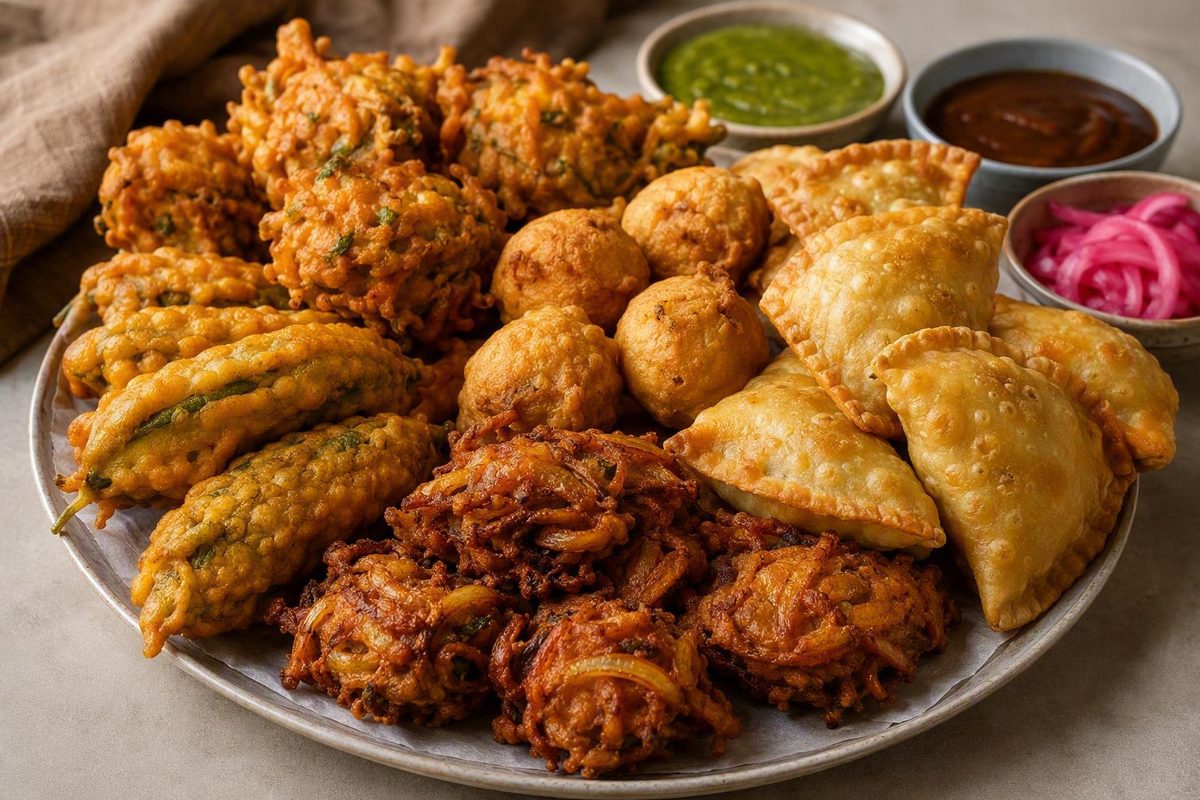
Deep-fried South Asian street food is not one uniform style of cooking. The phrase can describe lentil fritters, battered vegetables, stuffed pastries, fried breads, hollow shells, bun-based snacks, and sweets soaked in syrup. Some foods enter the oil as complete units; others combine one fried element with bread, lentils, chickpeas, chutney, or flavored water.
That distinction provides a practical way to read a menu. First identify the format: Is it a fritter, stuffed pastry, bread, shell, assembled snack, or sweet? Then consider its base ingredient, filling, accompaniments, and likely texture.
This is an introductory guide to 12 principal dishes, with bonda and bhajji included as related examples. It is not a ranking or a comprehensive survey. The available culinary evidence is overwhelmingly India-focused, with one documented connection to Sri Lanka and much less coverage of Pakistan, Bangladesh, Nepal, Bhutan, the Maldives, or Afghanistan.
What Counts as Deep-Fried South Asian Street Food?
Deep frying means cooking food while it is submerged in hot fat or cooking oil. That separates it from shallow frying, pan-frying, griddling, roasting, steaming, or adding a crisp garnish to an otherwise unfried dish. A general overview of deep-fried foods defines the method by submersion in hot fat, although appearing on such a list does not establish that a food is regularly sold by street vendors.
This guide covers two related groups:
- Foods that the supplied culinary or travel sources describe as both street food and deep-fried.
- Recognizable street-food dishes built around a deep-fried component, even though the complete serving is not submerged in oil.
Two separate labels are needed because frying method and street-food evidence are different questions.
Frying status
- Fully deep-fried item: The named food itself is submerged in oil. Samosa, pakora, dal vada, batata vada, kachori, bread pakora, jalebi, gulab jamun, and bonda fit this format.
- Assembled dish containing a fried component: A defining part is deep-fried, but the entire serving is not. Examples include the potato vada in vada pav, the hollow shell in pani puri, the bhature served with chickpeas, and the pakwan bread paired with lentils.
Street-food evidence status
- Explicitly documented here as street food: The supplied material directly describes the food or assembled dish as street food.
- Included in a street-food guide: A supplied travel or culinary source presents the item within a street-food context.
- Fried snack whose street-vendor status is not firmly established here: The food is documented as fried, but the evidence does not support a broad claim about how consistently it is sold by street vendors. Bonda is the clearest example.
These labels are not judgments about cultural significance. A food may be sold from carts, market counters, cafés, restaurants, or home kitchens, depending on location. Its name may also cover several regional preparations.
The examples below are therefore neither “the best” nor a definitive checklist. They are a format-based introduction to several commonly discussed dishes in an evidence set weighted heavily toward India.
At-a-Glance Guide to the Main Dishes
The quickest way to compare these foods is to separate the item being fried from everything added before or after frying. The principal base and texture descriptions below are recognition tools, not fixed recipes.
| Food | Format | Principal base or filling | Profile | Typical textural structure | Frying status | Street-food evidence in this guide |
|---|---|---|---|---|---|---|
| Samosa | Stuffed pastry or turnover | Potatoes, peas, lentils, or meat | Savory | Firm or flaky shell around a softer filling | Fully deep-fried item | Included in street-food sources |
| Pakora | Batter-coated fritter | Vegetables, paneer, chicken, or fish in chickpea-flour batter | Savory | Crisp coating around the selected ingredient | Fully deep-fried item | Included in street-food sources |
| Dal vada | Shaped lentil fritter | Soaked and ground lentils with seasonings | Savory | Crisp exterior and softer, coarse-textured center | Fully deep-fried item | Explicitly described as street food in South India and Sri Lanka |
| Batata vada | Potato fritter or snack | Seasoned potato mixture | Savory | Fried exterior around a soft potato center | Fully deep-fried item | Street-vendor status is not firmly established by the supplied evidence |
| Vada pav | Filled bread roll | Fried potato vada inside soft pav, often with chutneys or chilies | Savory | Soft bread, fried vada, and moist condiments | Assembled dish containing a fried component | Explicitly presented as street food |
| Kachori | Round stuffed dough snack | Seasoned lentils or peas in documented versions | Savory | Crisp dough casing around a dry or soft filling | Fully deep-fried item | Included in an India-focused street-food guide; associated there with Rajasthan and northern India |
| Bread pakora | Stuffed bread-based snack | Sliced bread with potato filling in one documented version | Savory | Fried exterior, bread layers, and soft filling | Fully deep-fried item | Included in an India-focused street-food guide |
| Pani puri | Filled hollow shell | Fried wheat or semolina shell filled after cooking with potato, chutney, spiced water, or other ingredients | Savory, tangy, or spicy | Brittle shell with moist or liquid filling | Assembled dish containing a fried component | Explicitly presented as street food |
| Chole bhature | Chickpea-and-bread pairing | Spiced chickpeas with fried bhature | Savory | Soft chickpeas paired with yielding fried bread | Assembled dish containing a fried component | Included in a street-food guide; associated there with Delhi and Punjab |
| Dal pakwan | Lentil-and-bread pairing | Lentils with thin pakwan bread | Savory | Soft lentils against thin, crisp bread | Assembled dish containing a fried component | Included in a street-food guide; associated there with Sindhi cuisine |
| Jalebi | Syrup-soaked batter coil | Fried batter and sugar syrup | Sweet | Ridged coil that absorbs syrup and may retain some crispness | Fully deep-fried item | Included in street-food sources |
| Gulab jamun | Syrup-soaked dough ball | Dough commonly made with milk solids | Sweet | Fried outer surface and soft, syrup-saturated center | Fully deep-fried item | Included in street-food sources |
The dal-vada classification and its South India–Sri Lanka connection come from a recipe source that explicitly describes it as a deep-fried lentil fritter and street food. An India-focused travel account supports the table’s descriptions and qualified regional notes for kachori, bread pakora, pani puri, chole bhature, dal pakwan, jalebi, and gulab jamun.
Two vendors can use the same name while changing the filling, dough, spices, chutneys, or proportions. Regional notes likewise indicate associations reported by the supplied sources, not exclusive ownership or definitive origin.
Bonda does not appear among the 12 principal entries because the evidence establishes it as a deep-fried potato snack more confidently than it establishes its street-vendor role. It remains useful as a related example when comparing potato-based fritters.
Fritters and Vada: Pakora, Dal Vada, Batata Vada, and Bonda
Fritters can look similar after frying, but their internal structures differ. The key question is whether batter surrounds a distinct ingredient or whether the principal ingredient is ground, seasoned, and shaped into the fritter itself.
Pakora generally follows the first model. A vegetable, piece of paneer, chicken, or fish is coated in spiced chickpea-flour batter and deep-fried. Turmeric, cumin, and coriander are possible batter seasonings, not mandatory ingredients in every version. A commercial overview of pakora preparation describes the recurring structural goal as a crisp exterior with a cooked interior.
The coated ingredient matters as much as the batter. An onion or other vegetable pakora is materially different from a paneer, chicken, or fish pakora even if the coating is similar. It is therefore unsafe to infer vegetarian suitability merely from the word pakora.
Dal vada, by contrast, is a shaped lentil fritter rather than a separate piece of food dipped in batter. In one documented method, lentils are soaked and drained, ground while retaining some coarse texture, mixed with aromatics and seasonings, shaped, and deep-fried. Onion, chili, curry leaves, ginger, garlic, or cilantro may be included, but that ingredient list represents one recipe rather than a universal standard.
The same source lists several names: parippu vada, paruppu vada, masala vada, dal vadai, and dalwada. Names and recipes vary across languages, communities, and regions, so these terms should not be assumed to identify one rigid formula. The documented preparation produces a crisp exterior and softer interior.
The structural contrast is straightforward:
- Pakora: Batter coats a distinct ingredient.
- Dal vada: Ground lentils form the body of the fritter.
- Shared characteristic: Both are fried as complete items and commonly contrast a firmer exterior with a softer center.
Batata vada belongs to the potato branch of the vada conversation. It can be served by itself or placed inside pav to form vada pav.
Bonda is also documented as a deep-fried potato snack. That evidence does not resolve every distinction between bonda and batata vada. A menu description or question to the vendor is more reliable than assuming the names are interchangeable.
A similar caution applies to bhajji and pakora. Both are described in the supplied material as spiced fritters from the Indian subcontinent, but that does not prove that the terms always mean the same thing—or always mean different things—in every region.
For practical menu reading, look for three clues:
- What forms the center? A vegetable, paneer, meat, fish, lentil mixture, or potato mixture?
- How is the exterior made? Is there chickpea-flour batter, another coating, or no distinct coating?
- Is it served alone or assembled? A potato vada becomes part of a different dish when placed inside pav with condiments.
Stuffed and Layered Savory Snacks: Samosa, Kachori, and Bread Pakora
Samosa, kachori, and bread pakora are all fried savory foods with an exterior and a filling, but they use different construction methods.
A samosa is a fried pastry or turnover. Its filling may include spiced potatoes, peas, lentils, or meat. Cumin, coriander, and garam masala are possible seasonings rather than a universal blend. Shape, pastry thickness, filling, and seasoning can change from one preparation to another; one street-food account describes vegetable and meat variations.
The defining structural feature is the pastry shell. The filling is enclosed before frying, producing a firm or flaky exterior around a softer center. That separates a samosa from an open fritter even when both contain potato.
Kachori is a round fried dough snack that may contain a seasoned lentil or pea filling. One India-focused travel source associates it with Rajasthan and northern Indian breakfast and snack traditions. That is a qualified regional association, not a claim of exclusive origin or availability.
Compared with a samosa, kachori generally presents as a rounded, enclosed dough form rather than a turnover with a folded pastry silhouette. Both can contain lentils or peas, so the ingredients alone do not reliably distinguish them. Casing and shape are more useful clues.
Bread pakora replaces a purpose-made pastry casing with sliced bread as part of the exterior. One documented form places potato filling between triangular bread slices before deep-frying. Other versions need not be identical, but the use of bread separates the format from samosa and kachori.
The structural comparison is simple:
- Samosa: Filling enclosed in a pastry shell.
- Kachori: Filling enclosed in a rounded dough casing.
- Bread pakora: Sliced bread forms part of the layered exterior around a filling.
All three are foods that are themselves fried, rather than assembled servings in which only one accompaniment enters the oil.
Exact dietary suitability therefore has to be confirmed from the recipe or vendor rather than inferred from the dish name.
Street-Food Dishes Built Around One Fried Component
Some of the most recognizable foods in this category should not be described as entirely deep-fried. They combine fried and unfried parts, with each component contributing a different texture.
Vada pav
Vada pav consists of a spicy fried potato vada served inside a soft bread roll called pav. Chutneys and green chilies may be added. The bread is not the same thing as the vada, and the condiments do not become “deep-fried” merely because they share the finished serving.
The distinction is:
- Batata vada: The fried potato snack itself.
- Vada pav: The assembled bun-based dish containing the potato vada.
Someone ordering batata vada should not necessarily expect bread and condiments. Someone ordering vada pav should expect the larger composition. A South Asian street-food description likewise identifies vada as the potato fritter and pav as the soft bun.
Pani puri
Pani puri begins with a hollow fried shell made from wheat or semolina in the documented preparation. After frying, the shell is filled with ingredients such as potato, chutney, and spiced water. Other fillings can vary.
Its defining contrast depends on timing: a dry, brittle shell receives moist or liquid ingredients shortly before it is eaten. Calling the complete serving deep-fried would obscure its construction. The shell is fried; the water, chutney, and filling are added afterward.
This component-level distinction also makes ingredient checks more precise. A diner may need to ask separately about the shell and its fillings rather than treating pani puri as one uniform mixture.
Chole bhature
Chole bhature pairs spiced chickpeas with deep-fried bhature. The bread is fried; the chickpea preparation is not accurately described as deep-fried simply because it appears on the same plate.
The supplied travel material associates the dish particularly with Delhi and Punjab. That describes a documented regional connection, not a boundary around where it may be prepared or served.
The pairing also differs from a filled pastry. The chickpeas are not enclosed in the bhature before frying. Bread and chickpeas remain separate components that the diner combines while eating.
Dal pakwan
Dal pakwan pairs lentils with thin, crisp, deep-fried pakwan bread. The supplied evidence associates it with Sindhi cuisine and describes it as a breakfast or snack.
A practical way to identify the dish is through contrast: soft or spoonable dal is eaten with brittle fried bread. Dal pakwan is therefore structurally different from dal vada. In dal pakwan, the lentils and fried bread remain separate; in dal vada, lentils are ground, shaped, and placed directly into the frying oil.
Component-level labeling may sound technical, but it prevents several misunderstandings. It identifies the source of the fried texture, clarifies ingredient questions, and shows home cooks which part of a dish requires deep-frying.
Syrup-Soaked Sweets: Jalebi and Gulab Jamun
Not all deep-fried South Asian street foods are savory. Jalebi and gulab jamun both combine frying with sugar syrup, but they differ markedly in composition, shape, and texture.
Jalebi is made by frying batter in coils or swirls and then soaking or dipping the fried forms in sugar syrup. One documented preparation flavors the syrup with cardamom and saffron, but those additions should be treated as possibilities rather than a universal prescription.
Depending on preparation and serving time, the exterior may retain some crispness while the channels and interior hold syrup. The essential recognition clue is the fried coil or swirl, not a filling or solid dough ball.
Gulab jamun takes the form of fried dough balls commonly made with milk solids and soaked in flavored sugar syrup. Cardamom, rose water, and saffron are possible syrup flavorings. Recipes and proportions vary, but the recurring structure is a fried outer surface around a soft center that absorbs syrup.
| Sweet | Fried form | What happens after frying | Main textural idea |
|---|---|---|---|
| Jalebi | Coil or swirl of batter | Soaked or dipped in sugar syrup | Ridged, syrup-filled coil that may retain exterior crispness |
| Gulab jamun | Rounded dough ball | Soaked in flavored sugar syrup | Soft-centered ball saturated with syrup |
Gulab jamun requires particular care in dietary labeling because it is commonly based on milk solids. It should not be described as vegan or dairy-free without confirmation of the exact recipe. Jalebi should not receive a universal dietary label either, because batter ingredients and preparation practices can vary.
Their forms provide the most useful distinction: jalebi is a syrup-soaked fried coil, while gulab jamun is a syrup-soaked fried ball.
How to Choose by Ingredient, Texture, and Dietary Needs
An unfamiliar dish name becomes easier to interpret when choices are organized by base ingredient and structure.
If you want a potato-based food
Several dishes can involve potato, but they place it in different formats:
- Potato-filled samosa: Potato sits inside a pastry shell, sometimes with peas or other ingredients.
- Batata vada: Potato forms the soft center of a fried snack.
- Vada pav: A fried potato vada is placed inside a soft bread roll, often with chutneys or chilies.
- Bread pakora: Potato filling is layered with bread in the documented version and then deep-fried.
- Pani puri: Potato may be placed inside a hollow fried shell with chutney and spiced water.
Choose according to the exterior you want. Samosa supplies pastry; batata vada supplies a fritter format; vada pav adds soft bread; bread pakora uses sliced bread; and pani puri offers a thin shell with a moist filling.
If you want lentils
Lentils can form the body of a fried item, sit inside a casing, or remain a separate accompaniment:
- Dal vada: Ground soaked lentils are seasoned, shaped, and fried.
- Kachori: Some versions enclose seasoned lentils inside dough.
- Dal pakwan: Lentils remain separate and are served with crisp fried bread.
- Samosa: Lentils are one possible filling, although potato, peas, or meat may appear instead.
These dishes are not interchangeable merely because they contain pulses. Dal vada emphasizes the lentil fritter, kachori emphasizes the enclosing dough, and dal pakwan emphasizes the contrast between soft lentils and fried bread.
If you want chickpea-flour batter
Pakora is the central choice. Its batter is commonly based on chickpea flour, but the ingredient underneath may be a vegetable, paneer, chicken, or fish.
Ask what has been coated rather than assuming that every pakora is a vegetable fritter. The same menu category can include versions containing dairy, meat, or seafood.
If texture is the priority
For a crisp shell or casing, consider:
- Samosa
- Kachori
- Pani puri
- Pakwan bread
For a soft-centered fritter, consider:
- Dal vada
- Batata vada
- Bonda
- Some pakoras, depending on the coated ingredient
For bread combined with a fried element, consider:
- Vada pav
- Chole bhature
- Dal pakwan
- Bread pakora, although its bread is part of the fried item rather than an unfried bun or separate accompaniment
For a syrup-soaked sweet, choose between the coiled form of jalebi and the soft-centered ball of gulab jamun.
If you have dietary restrictions
Do not assign vegetarian, vegan, gluten-free, dairy-free, or allergen-free status solely from a dish name.
Potential ingredients include:
- Meat: Some samosas contain meat.
- Dairy: Paneer pakora contains dairy, and gulab jamun commonly uses milk solids.
-
Chicken or fish: Either may appear inside pakora batter.
-
Variable accompaniments: Chutneys, curries, fillings, and syrups may introduce ingredients not apparent from the main name.
One published dal-vada recipe describes its particular preparation as vegan and gluten-free. That is useful information about that recipe, not a universal classification for every dal vada. Its ingredient and method notes illustrate one lentil-based version, while other preparations still need individual verification.
For a practical conversation with a vendor or restaurant, ask:
- What is in the batter or dough?
- What is in the filling or center?
- What is served with it as a chutney, curry, syrup, or garnish?
- Does the preparation or shared frying oil affect the dietary restriction you need to manage?
That approach is more dependable than assuming a potato or lentil base answers every dietary question.
Deep-Frying These Foods Safely at Home
Cultural descriptions explain what a dish is; safety guidance explains how to work with hot oil. The recommendations here come from general USDA Food Safety and Inspection Service guidance for home deep-fat frying, not from dish-specific South Asian cooking instructions.
Deep-frying oil can exceed 400°F, creating severe burn and fire hazards. Frying should never be left unattended, and water must never be used on a grease fire. When water contacts very hot oil, it can vaporize rapidly, expand, and throw burning oil outward, as explained in the USDA FSIS guidance on deep-fat frying.
Food should be added carefully so that the oil does not overflow or splatter.
Avoid overcrowding. Adding too much food at once lowers the oil temperature, which can produce greasy exteriors and delay cooking at the center. Fry in manageable batches and allow the oil to recover between them.
There is no single correct oil temperature for every food in this guide. Size, moisture, batter, filling, and recipe design all matter. One documented dal-vada recipe specifies approximately 375°F, but that number applies to that recipe’s proportions, shape, and method rather than to samosas, pakoras, fried breads, sweets, or every other vada.
Color and crispness alone do not establish that meat or seafood has reached a safe internal temperature. The supplied USDA FSIS guidance lists a minimum internal temperature of 165°F for poultry and 145°F for fish and shellfish. Because shellfish vary considerably in form, use the current USDA guidance and an appropriate dish-specific method rather than assuming that every item can be measured in the same way.
Used oil also requires inspection. Oil that is cloudy, foaming, foul-smelling, or foul-tasting should be discarded. Leftovers should be refrigerated within two hours, or within one hour when the surrounding temperature is above 90°F, according to the same USDA FSIS guidance.
Follow current emergency guidance and use an appropriate extinguisher or other method specified for a cooking-oil fire only when it is safe to do so.
Frequently Asked Questions
What qualifies as deep-fried South Asian street food?
At its narrowest, the category covers a street food that is submerged in hot oil as a complete item, such as samosa, pakora, dal vada, kachori, jalebi, or gulab jamun.
A broader definition includes assembled street-food dishes organized around one fried component. Vada pav contains a fried potato vada; pani puri uses a fried shell; chole bhature includes fried bread; and dal pakwan pairs lentils with fried pakwan.
The most accurate description identifies both the frying status and the strength of the available street-food evidence.
What is the difference between pakora and dal vada?
Pakora generally consists of a distinct ingredient—such as a vegetable, paneer, chicken, or fish—coated in spiced chickpea-flour batter and deep-fried.
Dal vada is formed primarily from soaked, ground, seasoned lentils. In short, pakora is usually a batter-coated ingredient, while dal vada is a shaped lentil fritter.
What is the difference between batata vada and vada pav?
Batata vada is the fried potato snack itself. Vada pav is an assembled dish made by placing a potato vada inside soft pav, commonly with chutneys or green chilies.
The first name identifies the fried component; the second identifies the bun, vada, and condiments as a combined serving.
Are deep-fried South Asian street foods vegetarian, vegan, or gluten-free?
Some individual recipes may fit one or more of those categories, but the names alone do not establish dietary suitability.
Samosas may contain meat, pakoras may contain paneer, chicken, or fish, and gulab jamun commonly contains dairy. Pastry shells, breads, and pani puri shells may contain wheat or semolina. Verify the batter or dough, filling, accompaniments, and preparation practices for the exact item.
What temperature should I use when frying these foods at home?
Follow a tested, dish-specific recipe and use an appropriate thermometer. There is no universal temperature for thin shells, stuffed samosas, lentil fritters, fried breads, and milk-solid sweets.
The approximately 375°F figure discussed above belongs to one dal-vada recipe. Whatever the dish, avoid overcrowding, monitor the oil continuously, and follow current food-safety guidance when frying poultry, fish, or shellfish.
A Format-Based Way to Read the Menu
The most reliable way to understand these foods is to identify their structure. Pakora and dal vada are fritters, but one coats a distinct ingredient while the other is formed from lentils. Samosa, kachori, and bread pakora all enclose fillings, but they use pastry, rounded dough, and sliced bread respectively. Vada pav, pani puri, chole bhature, and dal pakwan contain fried components without being entirely deep-fried. Jalebi and gulab jamun use syrup after frying but take the distinct forms of a coil and a ball.
Keep fully fried foods separate from assembled dishes containing one fried element, and verify the exact batter, filling, accompaniments, and preparation practices when dietary needs are involved. This India-heavy guide provides a starting framework for recognizing 12 dishes; it is not a complete account of South Asia’s varied fried-food traditions.