
How to Respond When the Roadside Is Unstable
It may consist of packed dirt, loose soil, sand, grass, gravel, partially paved material or a mixture rather than one required surface.
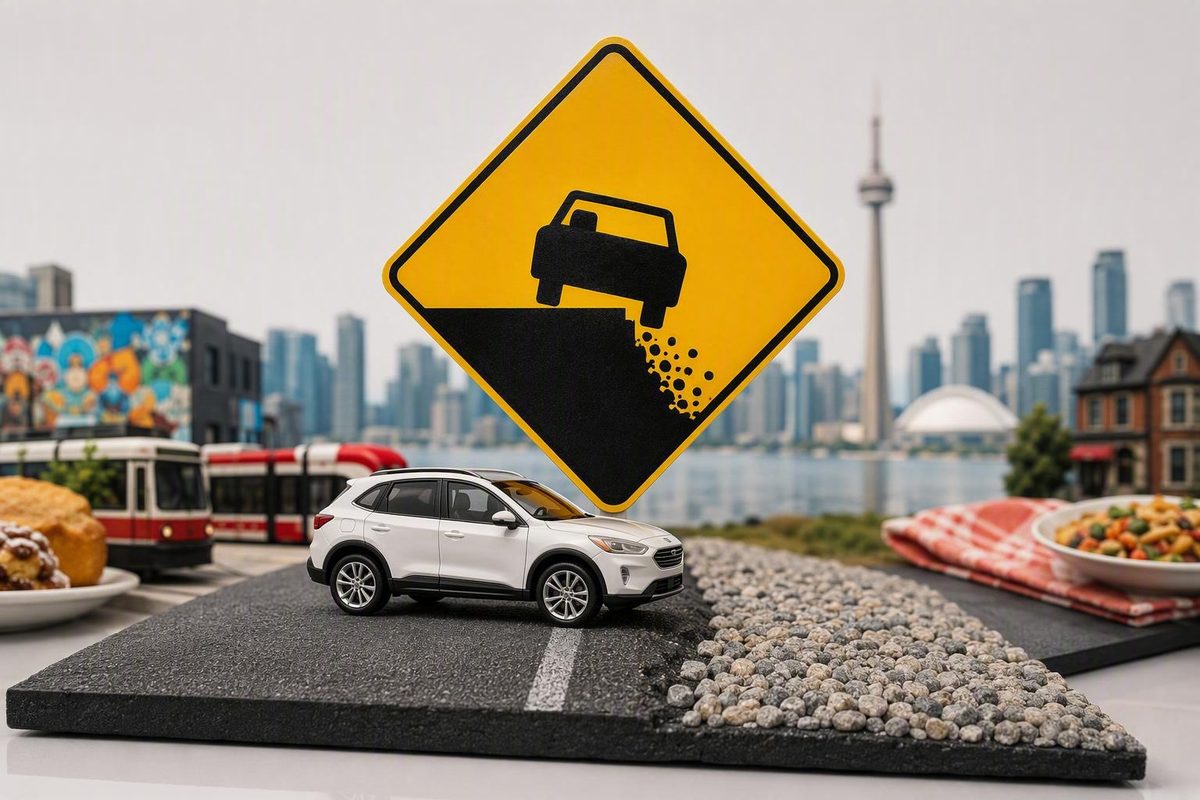
The short answer: the shoulder may not support normal driving
A Soft Shoulder sign warns that the roadside shoulder is less firm or stable than the paved travel lane and may be unsuitable for normal driving.
The shoulder is the area immediately outside the outer travel lane. It is not automatically an additional driving lane. The warning means that the surface beside the pavement may not provide the same traction or structural support as the asphalt or concrete roadway.
In this context, “soft” does not identify one required material. The shoulder may be unpaved, loosely compacted, uneven, or otherwise unable to support ordinary vehicle travel reliably. Commercial driver-education material likewise describes the sign as a warning that leaving the pavement may affect traction and make vehicle control more difficult (Safe2Drive’s explanation of the Soft Shoulder sign).
The practical response is simple:
- Remain within the marked travel lane.
- Pay closer attention to your position near the pavement edge.
- Do not treat the shoulder as a routine driving or passing lane.
- Recognize that the surface may behave differently if using it becomes unavoidable.
- Follow posted traffic controls, police directions, and the official rules for the place where you are driving.
The sign identifies a potential hazard, not a guaranteed outcome. Touching the shoulder does not mean a vehicle will necessarily skid, sink, become stuck, sustain damage, or crash. It means the driver should not assume that the roadside surface will perform like the paved lane.
The sign also does not establish a universal rule for driving, stopping, parking, or passing on a shoulder. For authoritative legal requirements and driving instructions, consult the current official driver handbook or transportation authority for the jurisdiction in which you are travelling.
What can make a road shoulder “soft”
A soft shoulder does not always mean gravel. Gravel is a common example, but the warning is broader than one surface type.
Depending on the road and local conditions, the shoulder may consist of:
- Gravel
- Packed dirt
- Loose soil
- Sand
- Grass or sod
- A mixture of natural and aggregate materials
- Partially paved or otherwise unstable material
- Material that is not compacted or engineered for normal vehicle travel
A U.S.-oriented permit-test resource describes soft shoulders as including gravel, packed dirt, and partially paved areas. It also notes that the shoulder may be uneven or lower than the roadway (DMV Permit Test’s Soft Shoulder overview).
The central issue is the difference between the travel lane and the roadside surface. A soft shoulder generally offers less dependable support or traction than the paved roadway. Loose material may shift under a tire, while inadequately compacted ground may deform or develop ruts.
A soft shoulder may also be uneven, lower than the adjacent pavement, or sloped away from the road. None of those features is required, however. A shoulder can appear level while still being unstable, and a lower shoulder is not necessarily soft.
Appearance alone may therefore be misleading. Smooth-looking dirt or grass should not be assumed to provide the same support as pavement. The warning sign should take priority over a quick visual judgment from inside the vehicle.
Conditions can also affect how an unstable shoulder behaves. Third-party safety material notes that wet, saturated, icy, thawing, or eroded ground may be less supportive than it appears. Dryness, however, does not guarantee that the shoulder can carry a vehicle reliably. These are possibilities rather than a measure of risk in any particular location.
Why the transition off the pavement can affect vehicle control
The principal concern is the change from a paved roadway to a less stable surface. When the wheels on one side of a vehicle remain on pavement while the other wheels enter gravel, dirt, grass, or another loose material, the two sides may encounter different traction and resistance.
Possible effects include:
- Reduced traction on loose or wet material
- A pull toward the road edge
- Uneven steering or braking response
- Skidding on a low-traction surface
- Sinking or rutting in poorly supported ground
- Sudden resistance against the shoulder-side wheels
- Difficulty returning to the paved lane
A commercial traffic-control company explains that unequal traction between wheels on pavement and wheels on a less stable shoulder can affect steering and braking (Worksafe Traffic Control’s soft-shoulder explanation).
A difference in height can add another handling challenge. If the shoulder is lower than the roadway, the tires must cross the pavement edge when returning to the lane. This does not mean every soft shoulder has a drop-off; surface stability and elevation are separate characteristics that can occur together.
Abrupt reactions may make a departure harder to manage. Sharp steering or hard braking can combine with unequal traction and cause the vehicle to respond differently from what the driver expects. That is why third-party safety guidance generally emphasizes controlled inputs rather than a hurried attempt to return to the pavement.
None of these effects is inevitable. The sign calls for caution; it does not predict a crash or vehicle damage.
Descriptions of rollovers and jackknifing appear in some material about large commercial vehicles, but those severe outcomes should not be treated as the expected result for an ordinary passenger vehicle. They are secondary examples of why unstable support can matter, not a prediction attached to the sign itself.
What to do when you see the warning
When you see a Soft Shoulder sign, remain within the marked travel lane and pay deliberate attention to the pavement edge. Do not use the shoulder for routine travel or as an improvised passing lane merely because it looks wide, level, or empty.
A measured response is more appropriate than a sudden manoeuvre:
- Check your lane position. Make sure the vehicle is not drifting toward the outer edge.
- Look ahead. Watch for curves, narrowing pavement, stopped vehicles, debris, pedestrians, cyclists, or a damaged road edge.
- Preserve space. Leave enough room to respond without sharp steering or hard braking.
- Account for conditions. Visibility, weather, traffic, and road geometry may reduce the margin available for correction.
- Avoid distractions. Close attention to lane position is especially important where the roadside is unstable.
- Continue obeying other traffic controls. A warning sign does not override regulatory signs, lane markings, or police directions.
The sign does not, by itself, prescribe one universal speed reduction. Safe2Drive broadly advises drivers to slow for warning signs, particularly on wet roads, but that is general educational guidance rather than a verified legal rule unique to Soft Shoulder signs. Speed must remain lawful and appropriate for the immediate road, visibility, traffic, weather, and vehicle conditions. If a reduction is appropriate, it should ordinarily be made smoothly rather than through sudden braking.
If a breakdown or emergency makes leaving the pavement necessary, remember that the shoulder may not support the vehicle reliably. Avoid abrupt entry when circumstances permit and follow the emergency procedures in the applicable official driver handbook. This article cannot determine whether stopping or driving on a particular shoulder is permitted in a specific location.
If your wheels leave the pavement
The following is limited, general guidance repeated by third-party driver-education and traffic-safety sources. It is not an official or universally safe recovery procedure. Road geometry, traffic, the vehicle’s response, and local instructions can change what action is appropriate.
If one or more wheels enter a soft shoulder, avoid turning a manageable departure into an overcorrection. Panic braking, sharp steering, or an aggressive immediate attempt to jump back onto the pavement may compound the difference in traction.
Commonly repeated guidance is to:
- Ease off the accelerator.
- Maintain controlled, deliberate steering.
- Avoid hard braking and abrupt turns.
- Allow speed to decrease gradually when conditions permit.
- Assess traffic and the road ahead.
- Return to the pavement smoothly only when it is safe.
A commercial traffic-safety article gives this same broad advice: ease off the accelerator, avoid hard braking and abrupt steering, slow gradually, and return when safe (Jackwin Safety’s discussion of soft-shoulder recovery).
This should not be treated as a rigid sequence. A driver must respond to the actual situation, including nearby vehicles, pedestrians or cyclists, curves, barriers, ditches, shoulder width, surface condition, and the vehicle’s behaviour.
Do not rely on online formulas involving an exact speed, steering angle, wheel position, or braking sequence. The evidence available here does not establish such instructions as official or suitable for every vehicle and roadway.
If the vehicle is sinking, stuck, damaged, pulling strongly, or unsafe to move, do not attempt a forceful recovery. Seek appropriate roadside or emergency assistance. If there is immediate danger, contact the local emergency service and follow responders’ instructions.
For authoritative roadway-departure guidance, use the current official driver manual for the province, state, territory, or country where you are driving.
Soft shoulder vs. hard shoulder, low shoulder, and drop-off
These roadside terms describe related but distinct conditions. Exact terminology may vary, so the comparisons below should be treated as general rather than universal official definitions.
Soft shoulder
A soft shoulder warning primarily concerns the roadside surface’s stability and ability to support a vehicle. The shoulder is generally unpaved or less stable than the travel lane, although it may include partially paved material.
The central question is whether the surface can be relied upon like the paved roadway. A Soft Shoulder sign warns that it may not be able to.
Hard shoulder
A hard shoulder is generally paved and more structurally supportive than a soft shoulder. It is commonly made of asphalt or concrete.
“Hard,” however, does not mean “ordinary travel lane.” Whether a paved shoulder may be used for stopping, emergencies, travel, or another purpose depends on the applicable signs and official local rules.
The basic distinction is:
- Soft shoulder: generally unpaved or less stable.
- Hard shoulder: generally paved and more supportive.
Low shoulder
A Low Shoulder warning generally emphasizes elevation: the shoulder sits below the adjoining roadway.
That is different from softness. A shoulder may be low but firm, soft but nearly level, or both low and soft. A third-party automotive overview treats Soft Shoulder, Low Shoulder, and Shoulder Drop-Off as separate warnings rather than interchangeable terms (CarParts.com’s comparison of road-shoulder signs).
Shoulder drop-off
A Shoulder Drop-Off warning generally emphasizes a more pronounced transition at the pavement edge rather than the shoulder’s surface material.
A drop-off may complicate the transition between the shoulder and roadway, but it does not establish that the shoulder is soft. Likewise, a shoulder can be soft without having a pronounced drop-off.
Because the evidence available here does not establish universal definitions or engineering thresholds, check the applicable road authority’s sign guide for the official meaning of each warning in the jurisdiction where you are travelling.
Sign appearance and local rules can vary
In U.S.-oriented permit-test material, a Soft Shoulder warning is commonly shown as a yellow, diamond-shaped sign with black lettering, often containing the words “SOFT SHOULDER.” The same material says the sign is placed before an area where the roadside shoulder is unpaved or soft.
That description should not be treated as a worldwide standard. The evidence available here does not establish one universal:
- Colour
- Shape
- Sign code
- Wording or symbol
- Placement distance
- Legal effect
- Rule for permanent and temporary conditions
Do not assume that a colour convention learned in one country applies everywhere. This article also does not claim that the sign falls under a particular official sign code, because no current government sign standard was supplied to verify that point.
It is useful to separate two questions:
-
What hazard is being communicated? The roadside surface may be less stable or supportive than the paved lane.
-
What are you legally permitted or required to do? Consult the current official handbook, posted controls, or transportation authority for the location where you are driving.
Visitors using rental vehicles should review the official driver handbook for their destination rather than relying on assumptions from home.
Frequently asked questions
Does a Soft Shoulder sign always mean the shoulder is gravel?
No. Gravel is common, but “soft” refers to inadequate stability or structural support rather than one required material.
The shoulder may consist of packed dirt, loose soil, sand, grass, gravel, partially paved material, or a mixture. It may also be uneven, sloped, or lower than the roadway, but those features are not required in every case.
The essential point is that the shoulder should not be assumed to behave like the adjacent asphalt or concrete.
Do I have to slow down when I see a Soft Shoulder sign?
The sign calls for caution, but the evidence available here does not establish a universal mandatory speed reduction.
Maintain a lawful speed appropriate for traffic, visibility, weather, road geometry, and available stopping space. A smooth reduction may be sensible when conditions leave little room for correction, but sudden braking can create another hazard.
For a permit-test answer or legal requirement, use the official driver handbook for the relevant jurisdiction.
Can I stop on a soft shoulder during a breakdown or emergency?
The sign warns about the shoulder’s surface support; it does not, by itself, establish whether stopping is permitted.
If an emergency makes a pull-off necessary, avoid abrupt entry when circumstances allow and recognize that the ground may not support the vehicle reliably. Follow the official emergency procedures for the location.
If the vehicle is unstable, sinking, damaged, or exposed to traffic, seek appropriate assistance rather than attempting a forceful return to the road.
What is the difference between a soft shoulder and a hard shoulder?
A soft shoulder is generally unpaved or less stable than the travel lane. A hard shoulder is generally paved and more structurally supportive.
A hard shoulder is not automatically a normal travel lane. Its permitted use must be determined from posted controls and the applicable official rules.
In short, “soft” and “hard” describe construction and support, not an automatic right to drive on the shoulder.
What should I do if my wheels drift onto a soft shoulder?
Avoid panic braking, sharp steering, and an aggressive immediate return to the lane. General third-party guidance recommends easing off the accelerator, steering in a controlled manner, allowing speed to decrease gradually when circumstances permit, checking traffic, and returning smoothly only when safe.
Adapt your response to the actual conditions rather than following a rigid formula. Traffic, road shape, shoulder width, obstacles, pavement height, and the vehicle’s response all matter.
If the vehicle is sinking, stuck, pulling strongly, damaged, or unsafe to move, seek roadside or emergency assistance instead of attempting an aggressive recovery. Consult the applicable official driver manual for authoritative instructions.
The practical takeaway is straightforward: a Soft Shoulder sign means the roadside may be less stable and less supportive than the paved lane. Stay on the pavement when possible, pay attention to the edge, and avoid abrupt reactions if a wheel leaves the roadway.