
How Credit Card Taps Reach the TTC Fare Cap
Credit cards join TTC’s 47-trip monthly fare cap on September 1, 2026. See how one card and the two-hour transfer window determine visitor costs.
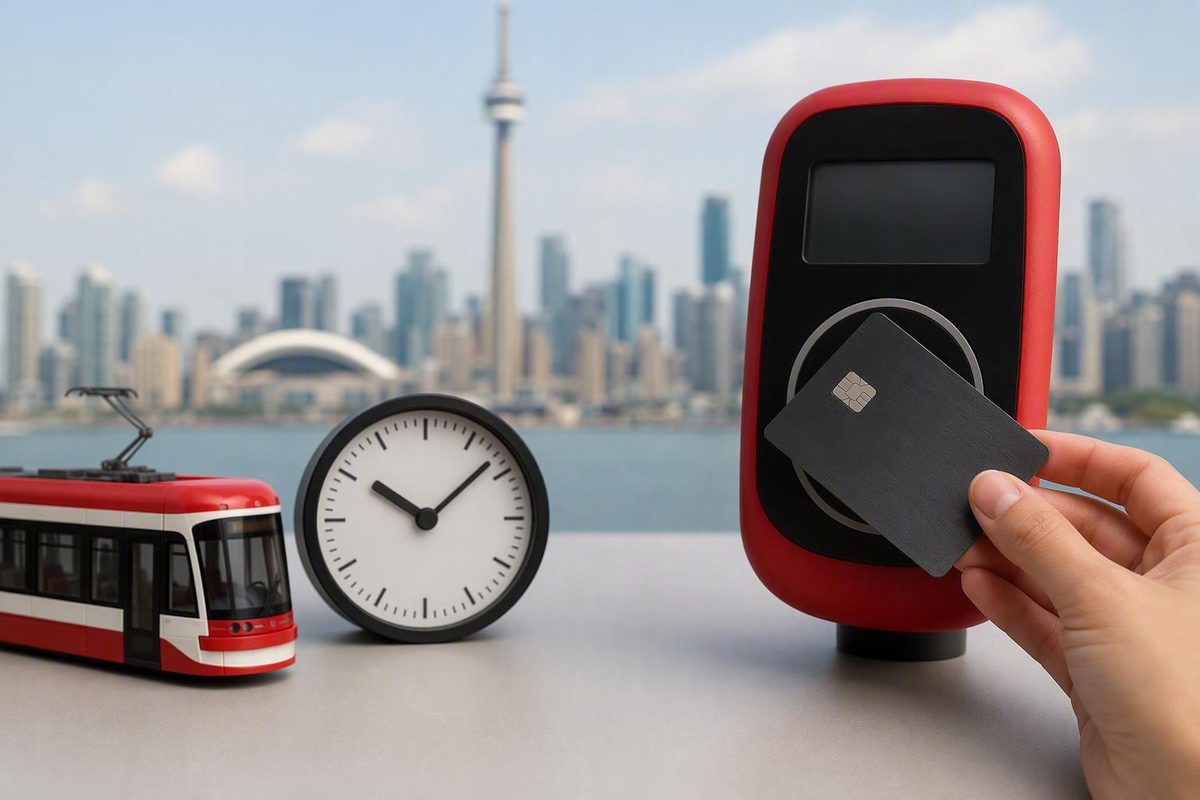
No—not yet. Direct credit-card taps do not receive TTC monthly fare capping on August 26, 2026. The program is scheduled to begin September 1, 2026, when 47 paid TTC trips on the same physical card or mobile device in one calendar month will make later qualifying trips free for the rest of that month. The 48th qualifying trip is the first free one.
Participation is scheduled to be automatic, with no registration or advance purchase required. Credit-card fares paid before September 1 will not count toward September. Travellers arriving around the launch should confirm on the TTC’s monthly fare-capping page that the program began as planned.
Enter your travel days and daily rides, then group rides that fit within the same two-hour transfer window.
Estimate paid fare periods—not just boardings—within one calendar month. The default five-day visit has four rides a day, paired inside two-hour windows.
You would not reach the 47-paid-trip cap.
~20 boardings become ~10 paid fare periods because two rides share each transfer window.
Estimate only: actual paid trips depend on the timing of each tap. Continue tapping after reaching the cap.
| Visit Pattern | Transfer Setup | Paid / Free | Estimated Cost |
|---|---|---|---|
| 2 days × 4 rides | 2 rides per window | 4 / 0 | $13.20 |
| 3 days × 6 rides | 3 rides per window | 6 / 0 | $19.80 |
| 5 days × 4 rides | 2 rides per window | 10 / 0 | $33.00 |
| 7 days × 6 rides | 2 rides per window | 21 / 0 | $69.30 |
| 12 days × 8 rides | 2 rides per window | 47 / 1 | $155.10 |
| 24 days × 4 rides | 2 rides per window | 47 / 1 | $155.10 |
Each row is an illustrative estimate. “Paid / Free” applies the announced cap after 47 paid trips in one calendar month.
Sources: TTC monthly fare-capping announcement and PRESTO’s TTC two-hour transfer guidance. Scheduled launch: September 1, 2026. Direct-card adult fare supplied: $3.30. Old monthly-pass prices and reduced PRESTO fares were not supplied.
The Cap Requires 47 Paid Trips on One Credential
The scheduled threshold is 47 qualifying paid TTC trips completed with one consistent payment credential during one calendar month. Trips one through 47 are paid. The 48th qualifying trip and later qualifying trips are scheduled to be free until the month ends.
A qualifying credential can be one physical credit card, one physical debit card, one PRESTO card, or one mobile device containing an eligible card. There is no separate cap to purchase.
The calendar-month limit matters. If a rider finishes September with 40 paid trips, those trips do not leave only seven to complete in October. The count resets to zero when the new month begins.
A visitor arriving near the end of a month has less time to reach the threshold. Even a longer visit may not reach it because the cap counts charged fare periods, not every boarding or reader tap.
At the listed direct credit- or debit-card adult fare of $3.30, the maximum charged amount represented by 47 paid trips is $155.10. That calculation assumes the fare remains $3.30. Current prices should be checked on the official TTC fare table before travel.
A Physical Card and Its Phone Wallet Do Not Share Progress
Use the same physical card or the same mobile device throughout the month. A physical card, phone, and watch should be treated as separate payment credentials even when they draw from the same underlying bank account.
For example, 25 paid trips made with a physical credit card and 22 made through that card’s phone-wallet version do not necessarily produce one 47-trip total. The physical card may hold a count of 25 while the phone holds a separate count of 22. Neither credential has reached the cap.
The same problem occurs when alternating between two physical cards or mixing credit, debit, and PRESTO. Thirty trips on one card and 17 on another do not combine into 47. The available TTC guidance does not indicate that separate totals can be merged.
Choose one of these methods and keep it consistent:
- one physical credit card;
- one credit card on one smartphone;
- one credit card on one smartwatch; or
- one PRESTO card.
If battery life or access to a device is a concern, a physical card may be the simpler choice. Using another method when necessary is allowed, but the trip made with it may build a different cap total.
The Two-Hour Transfer Window Matters More on Short Visits
A paid trip begins when the first tap opens a two-hour TTC transfer period. Later TTC taps within that valid window do not incur another fare and do not add another paid trip toward the monthly cap. PRESTO’s TTC guidance explains that the first tap starts the two-hour period.
Suppose a rider taps at 8:00 a.m. and transfers at 9:00 a.m. Both taps fall within the same two-hour window. The sequence normally adds one paid trip to the monthly total, not two.
A sightseeing route can involve a subway entry, a streetcar connection, and another permitted transfer while advancing the cap by only one paid trip. The rider must still tap wherever required, but each tap is not a new charge.
A journey beginning after the two-hour period expires can open another paid trip. The useful number for cost planning is therefore the number of separate charged travel periods, not the number of vehicles boarded.
Always use the same credential during a transfer. Starting with a physical card and then tapping its phone-wallet version may cause the system to identify two credentials rather than one continuous transfer.
This rule usually matters more than fare capping for a short stay. A visitor making four boardings a day may create only two paid fare periods if the boardings are paired inside two-hour windows. Over five days, that pattern produces about 10 paid trips—far below the 47 required before free travel begins.
Most Visitors Will Not Reach the Cap
Reaching the cap requires enough separately charged TTC travel to complete 47 paid fare periods before the calendar month ends. A rider averaging two paid periods per day would need 24 travel days to move beyond the cap: 47 paid trips would be completed during that span, with the next qualifying trip becoming free.
Compact sightseeing days make the threshold harder to reach. Grouping nearby destinations within one transfer period reduces the number of fares charged. That saves money immediately, but it also means slower progress toward 47.
A short-stay visitor should generally plan around the two-hour rule rather than expect fare capping to reduce the trip cost. The cap becomes more relevant on a long stay with frequent morning, midday, and evening journeys separated by more than two hours.
There is no saving in taking unnecessary trips to reach the threshold. The first 47 paid trips still cost up to $155.10 at the listed direct-card adult fare. The benefit appears only when the rider’s normal travel would continue beyond those 47 paid trips in the same month.
Organizing attractions by area or following city sightseeing with regional travel also affects the estimate. Closely grouped TTC rides may share a transfer window, while regional journeys do not count toward the TTC cap.
Direct Card Taps Charge the Adult Fare
The listed direct Interac Debit or credit-card fare is the TTC adult fare of $3.30. Youth, Senior, and Fair Pass discounted prices are not available through direct credit- or debit-card payment.
A credit card can therefore qualify for the scheduled cap while still being the wrong payment choice for someone eligible for a reduced PRESTO fare. Discount eligibility and fare-cap eligibility are separate questions.
The Adult, Youth, Senior, and Fair Pass monthly passes are scheduled to be discontinued August 31, 2026. The supplied evidence does not include the old monthly-pass prices, so a reliable dollar comparison with those passes cannot be stated here. The calculator leaves that field blank unless the reader enters the relevant former price.
Visitors who do not qualify for a discount may prefer a direct card because it avoids obtaining and loading another fare card. That convenience does not guarantee savings. A rider who finishes the month below 47 paid trips simply pays for the qualifying trips taken.
Keep Tapping After the 47th Paid Trip
Reaching the cap does not remove the requirement to tap. Continue presenting the same physical card or mobile device when entering a station or boarding a vehicle.
The credential remains necessary for entry and Proof-of-Payment. TTC guidance says the physical card or mobile device used for the tap must be available if requested; the requirement is covered in the TTC’s Proof-of-Payment guidance.
After reaching the cap:
- Tap the same card or device.
- Confirm that the reader accepts it.
- Keep it available during the trip.
- Present it if Proof-of-Payment is requested.
The fare treatment changes after the cap, but the tapping procedure does not. A rider who reached 47 with a phone should not switch to the physical version of that card for the 48th trip.
The supplied guidance does not explain exactly how free post-cap trips will appear in a banking app, pending-transaction list, or card statement. Do not rely on a particular transaction description or zero-dollar entry as proof that a trip was recorded.
Card Riders May Need to Count Paid Trips Manually
The TTC does not promise an approaching-cap notification for direct credit- or debit-card riders. Its fare-capping guidance tells those riders to review their activity and count their trips.
Count the first tap that begins each new two-hour fare period. Exclude subsequent transfer taps made during that period. A bank statement may not present the information as clearly as a dedicated transit counter, so a phone note can be useful.
| Time | TTC Activity | Cap Progress |
|---|---|---|
| 8:00 a.m. | New fare period | +1 |
| 9:00 a.m. | Transfer within two hours | +0 |
| 1:30 p.m. | New fare period | +1 |
| 2:15 p.m. | Transfer within two hours | +0 |
This example contains four taps but only two paid trips. A personal record is a planning aid rather than a replacement for the transit payment system’s record.
Reset the record at the start of each calendar month. Continue tapping normally even when your own count reaches 47.
Regional Transit Does Not Count Toward the TTC Cap
The cap applies to qualifying trips that start on the TTC. GO Transit and other regional-agency fares do not build the TTC total, even when the same credit-card account is used to pay them.
TTC and regional fare caps remain separate. Track TTC paid periods independently from regional journeys and airport or intercity transportation.
Does the 48th TTC Trip Become Free?
Yes, if the first 47 qualifying paid trips were recorded on the same physical card or mobile device within one calendar month. The 48th qualifying trip is scheduled to be the first free trip. The rider must still tap the same credential.
Must a Credit Card Be Registered?
No. The scheduled cap is automatic and does not require registration, an opt-in, or a monthly purchase. Consistent use of one card or device is still required.
Do Transfer Taps Count as Separate Trips?
No. Additional taps inside a valid two-hour transfer period do not add paid trips to the cap. They must still be made wherever TTC rules require tapping.
Does Debit Card Fare Capping Work the Same Way?
The announced program includes direct debit-card taps as well as credit cards and PRESTO. A debit-card rider must follow the same one-credential and calendar-month rules.
Do August Trips Count Toward September?
No. The program is scheduled to start September 1, and the cap operates by calendar month. August taps do not become progress toward September’s 47 paid trips.