
Plan a Focused Half-Day at the Waterfront Science Centre
See what the interim waterfront Science Centre includes, who it suits, ticket costs, timed-entry rules, transit directions, and half-day pairings.
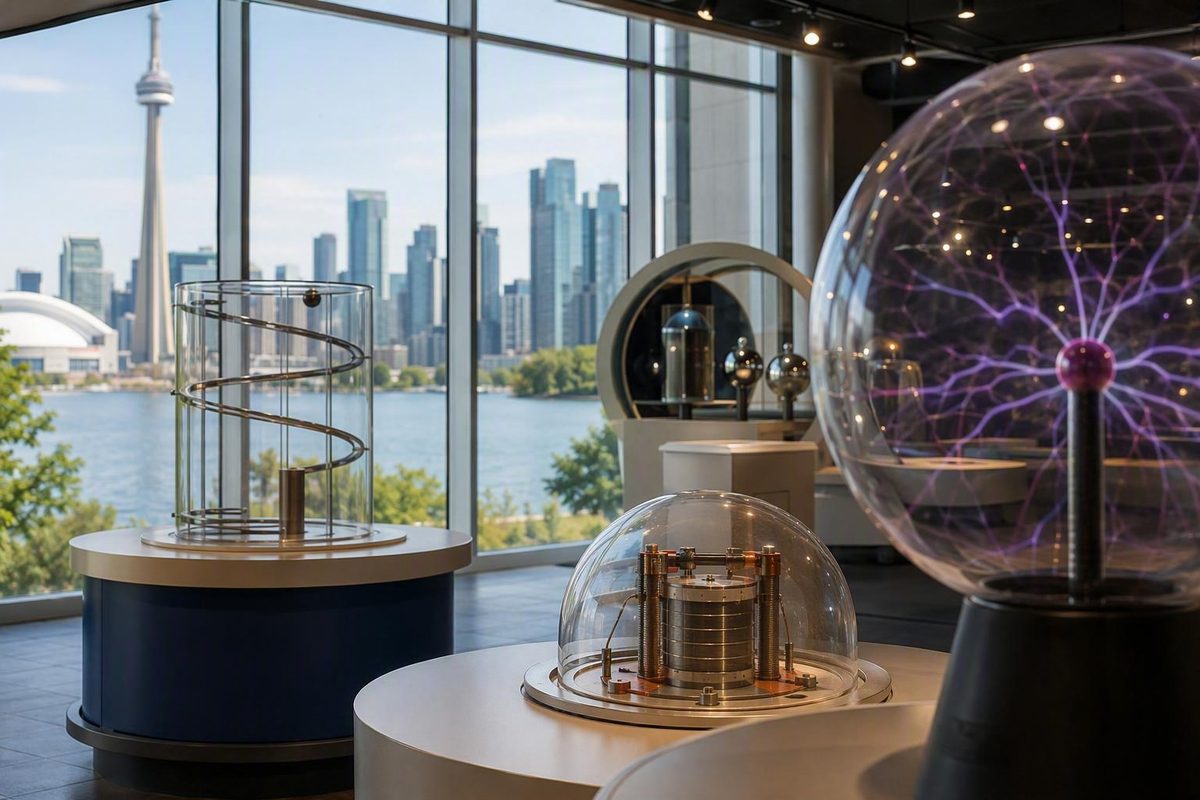
The Ontario Science Centre at Harbourfront is a compact interim attraction best suited to a two- or three-hour visit, especially for families with children under 12, space enthusiasts and hands-on makers. Admission is $15 including tax, timed slots can sell out, and the 509 Harbourfront or 510 Spadina streetcar runs from Union Station to the Harbourfront Centre stop. Pair it with the Toronto Islands ferry or a waterfront walk rather than expecting the full-day scale of the former Don Mills complex.
Choose your group, date, arrival time and waterfront add-on; the planner calculates admission and builds your visit order.
Set the group, visit date, entry time and next stop. The calculator applies the published admission rules and arranges three 40-minute gallery blocks.
| Visitor | Regular Price | June 19–Sept. 7, 2026 Online | Best Starting Area |
|---|---|---|---|
| Age 0–2 | Free | Free | KidSpark |
| Age 3–17 | $15 | Free | KidSpark, Space Deck or Innovation Station |
| Age 18–24 | $15 | $7.50 | Space Deck or Innovation Station |
| Age 25+ | $15 | $15 | Space Deck |
The calculator does not apply the separate 20%-off procedure for groups of 20 or more, complimentary Indigenous admission or support-person admission. Confirm eligibility while booking.
Source: Ontario Science Centre published admission, hours, exhibit and transit information. Admission is $15 including tax; Canada Strong Pass terms apply only to qualifying online bookings through September 7, 2026.
The Interim Centre Has Three Ticketed Galleries
The Science Centre is inside Harbourfront Centre at 235 Queens Quay West, at Lower Simcoe Street. It opened on June 29, 2026, as the first public Ontario Science Centre location since the Don Mills building closed.
This is not a reproduction of the former building. Don Mills covered approximately 568,000 square feet; the interim site is expected to reach approximately 86,000 square feet once fully operational. That figure does not establish how much space will be accessible on a particular date.
The permanent Ontario Place facility, where ground was broken in May 2026, has been reported as targeting a 2029 opening. That remains a projection rather than a guaranteed opening date (Canadian Press reporting published by Canadian Architect).
The smaller footprint makes Harbourfront easier to navigate with young children and easier to combine with another waterfront activity. The trade-off is breadth. Adults and teenagers expecting a large museum with enough galleries for a full day may find it short.
Older reviews mentioning the former IMAX theatre, rainforest, science arcade, parking arrangements or sprawling multi-level layout refer to Don Mills. They do not describe the Harbourfront venue.
Space Deck Centres the Visit on Astronomy
Space Deck includes a planetarium experience, Canadian contributions to space exploration, a piece of the Moon, astronaut dress-up, constellation observation and other hands-on activities. Harbourfront Centre’s exhibit overview documents the principal features in Space Deck, Innovation Station and KidSpark.
General admission includes Space Deck, but that does not establish that planetarium presentations run continuously or have unlimited capacity. If the planetarium is your priority, confirm its schedule and access arrangements before choosing a timed entry.
Space Deck is the strongest starting point for adults, teenagers and children particularly interested in astronomy. Younger children may concentrate on dress-up, while older visitors are more likely to spend time with the Moon sample, constellations and Canadian space material.
Innovation Station Rewards Repeated Experimentation
Innovation Station is the maker-oriented gallery. Visitors build, create, test ideas and solve problems with tools and varied materials.
It is a good match for children and teenagers who prefer manipulating objects to reading display panels. The amount of time required varies: one visitor may complete a challenge once, while another may repeatedly revise the same design.
Visitors seeking extensive object collections or tightly structured demonstrations may move through more quickly. For a two-hour visit, choose one or two activities rather than treating every station as mandatory.
KidSpark Is the Strongest Area for Children Under 10
KidSpark is primarily intended for children age 10 and under. Its documented activities include a pretend supermarket, construction and mechanics play, medical and veterinary role-play in the Health Hub, and a Pond area with balancing, pretend fishing and reading.
Preschoolers and younger elementary-age children may spend most of the visit here because the role-play has no fixed endpoint. If KidSpark is the main reason for attending, begin there while the child’s energy is highest.
Children age 2 and under enter free, but not every activity in the building is designed for toddlers. A toddler-led outing may reasonably consist of a long KidSpark session, a brief look at Space Deck and a waterfront break.
Curiosity Commons Adds Outdoor Sports Science
Curiosity Commons is an outdoor learning space with free programming related to motion, athletic performance and sports science. Additional exhibits, programs and spaces were expected later in 2026, reinforcing the interim site’s evolving nature (Ontario government opening announcement).
Available visitor information does not establish whether Curiosity Commons operates continuously, seasonally or in poor weather. Treat it as an optional extension rather than the activity that determines whether admission is worthwhile.
The Best Audience Is Families and Interest-Led Visitors
| Visitor | Start Here | Main Trade-Off |
|---|---|---|
| Toddlers and preschoolers | KidSpark | Other areas may require more attention or dexterity |
| Children 5–10 | KidSpark or Innovation Station | One favourite area may consume most of the visit |
| Older children and teens | Space Deck or Innovation Station | Less breadth than a full-scale science museum |
| Adults with children | The child’s priority area | Adults may act mainly as facilitators in KidSpark |
| Adults without children | Space Deck | Usually better as a compact visit than a full day |
| Sports-focused visitors | Curiosity Commons | Outdoor availability needs checking |
Children under 10 have the broadest fit because KidSpark can anchor the visit while Space Deck and Innovation Station provide contrasting activities. A space-focused seven-year-old may still prefer Space Deck first, and a child who builds constantly may spend longer in Innovation Station.
Space Deck and Innovation Station are the stronger choices for teenagers. Those with a specific interest in astronomy, engineering or making are more likely to find enough substance than teenagers expecting the range of the former Don Mills location.
Adults without children should decide primarily on their interest in space and hands-on experimentation. The Moon sample and planetarium component can support a worthwhile focused visit, but available evidence does not justify treating the venue as an all-day adult museum.
The most reliable routing rule is to start with the area that matters most to the person whose attention or energy will fade first. Do not assume there will be time to return after presentations, crowds, hunger or a long KidSpark session change the plan.
Allow About Two Hours Inside
The Science Centre’s official organized-group guidance recommends approximately two hours to explore exhibits and activities at a comfortable pace (official group-visit guidance). Two to three hours is a sensible flexible range for individual visitors, not an official guarantee.
For a mixed-age group, divide a two-hour visit into three approximate 35- to 40-minute blocks:
- Begin in Space Deck while attention is fresh and check the planetarium arrangements.
- Move to Innovation Station and complete one or two making activities.
- Finish in KidSpark for younger children or Curiosity Commons when outdoor programming is available.
Families with toddlers or preschoolers should reverse that order. Start in KidSpark, then choose either Space Deck or Innovation Station according to remaining energy. Add Curiosity Commons only when weather, timing and interest align.
Planetarium timing should override any preset route. A child absorbed in role-play can also extend KidSpark beyond the planned block, while an adult group concentrating on Space Deck and one making activity may finish sooner.
A Ferry or Waterfront Walk Makes the Strongest Pairing
The venue’s compact format works well with another waterfront or downtown stop, but keeping the day beside the lake avoids unnecessary cross-city travel.
The Toronto Islands ferry is the more substantial pairing. Book an earlier Science Centre slot, finish the galleries, then continue toward the nearby ferry terminal. Ferry schedules, queues and island conditions are separate from Science Centre admission and should be checked independently.
A Harbourfront walk is the lower-commitment option. It can expand or contract around children’s energy, weather and the actual gallery visit. Curiosity Commons can form part of that outdoor portion when programming is operating.
Avoid placing a tightly timed attraction across the city immediately afterward. A delayed planetarium component or extended KidSpark session should not disrupt the rest of the day.
Admission Is $15 With Date-Specific Discounts
Published general admission is $15 per visitor, including tax. Children age 2 and under enter free. The ticket storefront may display $13.27 for paid age categories, but $15 is the clearest budgeting figure before checking the final purchase total.
From June 19 through September 7, 2026, the Canada Strong Pass provides free admission for visitors age 17 and under and 50% off for visitors age 18–24 when tickets are booked online. The offer does not apply to camps or group visits and cannot be combined with other discounts.
Because the interim venue opened June 29, the promotion applies there from opening day through September 7. Outside the promotion period, the published $15 admission applies to visitors older than 2 unless another documented provision applies.
Other provisions include complimentary general admission for Indigenous visitors, subject to available space, and free admission for a support person accompanying a visitor with a disability upon disclosure or presentation of a recognized card such as an Access 2 Card or Easter Seals Disability Travel Card.
Groups of 20 or more can receive 20% off admission, but group procedures are separate from ordinary individual booking. The prices, promotion terms and access provisions are documented on the official admission and hours page.
Timed Entry Is Recommended
Online booking requires selecting a date and available time, paying and receiving the tickets by email. Advance purchase is recommended rather than described as universally mandatory.
Walk-in tickets may be sold when the relevant slot has not sold out, while visitors with online timed tickets receive priority. Arriving after the venue opens does not guarantee immediate entry. Reserve ahead when a ferry sailing, meal or other timed activity depends on your Science Centre slot.
The published hours are:
| Day | Hours |
|---|---|
| Monday–Friday | 10 a.m.–6 p.m. |
| Saturday | 10 a.m.–8 p.m. |
| Sunday | 10 a.m.–6 p.m. |
Third-party listings have displayed conflicting hours, including a Monday closure. Use the official Science Centre page for operational decisions and recheck it before travelling.
The 509 And 510 Connect Union To Harbourfront
From Union Station, follow signs for the waterfront streetcars. Take either the 509 Harbourfront or 510 Spadina and exit at the Harbourfront Centre stop. The destination is 235 Queens Quay West, at the southwest corner of Queens Quay West and Lower Simcoe Street.
The 509 operates between Union and Exhibition stations. The 510 operates between Spadina and Union stations. The Science Centre’s official directions confirm both routes and the stop.
Check live TTC service before departure because construction, diversions or replacement buses can change the practical route. The available information does not provide a reliable streetcar travel time, so leave a buffer before the timed entry rather than building a connection to the minute.
Drivers have two documented paid options: underground parking at 235 Queens Quay West and above-ground parking one block west near Rees Street and Queens Quay West. Current rates, capacity and garage height restrictions are not established in the available information.
Accessibility And Visitor Services Need Advance Confirmation
The exhibition space and washrooms are documented as wheelchair accessible. That statement does not confirm that every outdoor surface, exhibit interaction or route meets every visitor’s needs. Contact the venue before buying a fixed-time ticket if step-free routing, elevator access, transfer space or access to a particular interactive element is essential.
Official organized-group information says food and drink are not allowed in exhibit areas. Groups may use the Landing Pad for eating, subject to seating availability, or available outdoor public space. The same guidance lists all-day lockers at $4 each.
Those are group policies, not confirmed promises for individual visitors. Available information does not clearly establish general-admission locker access, café service, outside-food rules, re-entry, stroller parking, family washrooms, nursing space, sensory accommodations, hearing support or designated quiet areas.
Ask directly if food, medication, baby supplies, luggage, bulky clothing or accessibility requirements will materially affect the visit. Curiosity Commons is outdoors, and no general poor-weather or cancellation policy is established in the available visitor information.
Before leaving, confirm official hours, the timed ticket, planetarium arrangements and operating galleries. Check Curiosity Commons if it matters to the plan, review live TTC service, and make sure any reviews used for planning describe Harbourfront rather than Don Mills.